

Table of Contents
- What In-Home Grandfather Clock Repair Service Covers
- How to Prepare for Your In-Home Service Appointment
- What Happens During an In-Home Checkup and Repair
- Troubleshooting Grandfather Clock Chime Issues Before You Call
- Your Grandfather Clock Maintenance Schedule
- How to Choose a Qualified Clock Repair Specialist
- Repair Costs and What Affects Your Estimate
- Conclusion: Protecting Your Heirloom for the Next Generation
- Frequently Asked Questions
Last Updated: October 5, 2026
What In-Home Grandfather Clock Repair Service Covers
An in-home grandfather clock repair service brings a qualified specialist to your living room to diagnose, clean, adjust, and repair a tall-case clock without it leaving your home. At Josef & Joseph, we make house calls across South Florida, Louisiana, and the Bahamas because moving a grandfather clock is the most dangerous thing you can do to it.
A service call typically covers four things:
- A physical checkup of the case, dial, hands, weights, and pendulum
- Inspection of the clock movement, including wear on pivots, bushings, and escapement
- Chime and strike repair, from misaligned hammers to bent chime rods
The alternative is workshop restoration: dismantling the movement and rebuilding worn parts at a bench, the right path for a seized movement or one needing new bushings.
When to Choose On-Site Repair vs. Workshop Restoration
Choose on-site repair when the clock runs but drifts, chimes at the wrong hour, or has stopped after a move. Choose workshop restoration when the movement is worn out, a mainspring has failed, or parts must be fabricated. The dividing line: if the problem lives in the case, setup, or chime linkage, we fix it where the clock stands; if it lives inside the movement, the movement comes to the bench.
How to Prepare for Your In-Home Service Appointment
A grandfather clock is a precision machine inside a piece of furniture, and the technician's first job is to determine which is causing the problem.
Work through this checklist the day before the visit:
- Clear a 3-foot working perimeter around the clock, including the front, so the technician can open the hood and reach the movement
- Remove rugs, floor lamps, and anything the technician could trip over, a stumble near a tall case is how pendulums get bent
- Locate the door key, winding key, and any pendulum shipping hardware
Write the symptoms down. "It chimes five at three o'clock" tells a specialist more than "it sounds wrong," and "it stopped Tuesday night after I wound it" points toward a jammed cable rather than a worn movement.
What Information to Have Ready
Before the technician arrives, gather three categories of information:
- The clock's identity. Maker, model if known, serial number, and approximate age. A serial number lets a specialist look up the movement type and know what parts are likely inside.
- The clock's history. When was it last serviced? Was it moved recently? A clock that ran fine for 20 years and stopped after a move has a very different diagnosis than one drifting for months.
- The symptoms in detail. Does the pendulum swing? Does it tick evenly? Does it chime at the right hour? Does it lose or gain time, and by how much per day? Write what you observe, not what you assume.
Questions to Ask Before the Technician Arrives
A short phone call before the visit saves everyone time. Ask:
- What is the service-call fee, and does it apply toward the repair if you proceed? Some shops waive the trip charge if you approve the work; others do not.
- What is your typical diagnostic process, and how long does it take? A specialist should describe the sequence, visual inspection, movement check, beat setting, timed run, without hedging.
- Do you carry common parts on the truck, or must everything be ordered? This determines whether a simple fix happens the same day or needs a second visit.
Safety First: When Not to Move or Adjust Your Clock
Never move a grandfather clock to "help" before a service call. Tall-case clocks are top-heavy, and the weights and pendulum are designed to hang, not travel.
Do not:
- Tip the case to vacuum underneath it
- Remove the weights to lighten the load
- Pull the pendulum off to stop the chime
A dropped weight can crack the case bottom and bend the pendulum crutch. A bent chime rod changes the tone permanently. Antique case joints are held by hide glue dried for a century; tipping the case can open them in seconds.
If the clock must be moved, for a renovation, floor refinishing, or relocation, call a specialist first. Moving a tall-case clock correctly means removing the weights and pendulum, securing the movement, and transporting the case upright. That is a service call, not a DIY project.
What Happens During an In-Home Checkup and Repair
A standard in-home checkup follows a fixed sequence: visual inspection, movement diagnosis, cleaning, adjustment, and a timed test run.
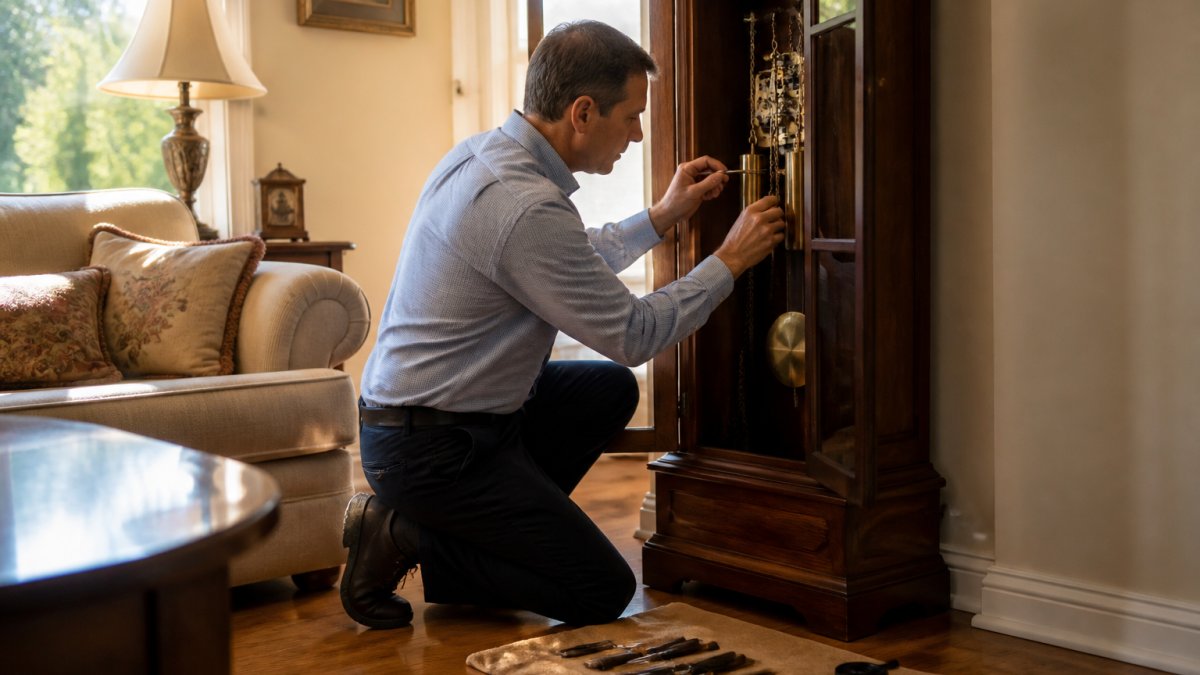
The visit starts with the case: loose moldings, a cracked backboard, and whether the clock sits level. A grandfather clock that leans even slightly will stop.
Finally, we run the clock through a full hour and half-hour cycle to confirm the chime and strike land on the right notes at the right time.
Diagnosing Clock Movement and Mechanical Problems
Diagnosis starts with one question: does the pendulum swing at all? A pendulum stopping within minutes points to a power or beat problem; one that swings but never drives the hands points to a slipping clutch or broken pinion.
From there, a specialist checks:
- Power: are the weights descending, or is a cable jammed on its drum?
- Beat: is the tick-tock even, or lopsided?
- Escapement: does the anchor engage the escape wheel cleanly?
Worn pivot holes are the most common mechanical failure in any mechanical clock. When the hole wears oval, the gear train loses alignment and the clock loses power. The fix is bushing work at the bench.
Troubleshooting Grandfather Clock Chime Issues Before You Call
Most chime problems are setup issues, not broken parts. Before calling for service, check whether the clock is level, whether the chime selector is set to the mode you expect, and whether the hands are seated correctly on their shafts.
Run through this order:
- Check the chime mode. Many clocks offer Westminster, Whittington, and silent. A clock "not chiming" is often in silent mode.
- Check the hour hand position. If the hour hand has slipped on its shaft, the chime will strike the wrong number.
- Check the level. Use a spirit level on the case top. A leaning clock can strike, then miss the next hour.
- Check for a bent hammer or rod. Look for a hammer resting against a rod instead of hovering just above it.
- Check the weights. If the chime weight has reached the floor, the chime stops until you wind it.
If the chime plays but sounds wrong, the notes are out of sequence, or a hammer misses its rod, that is a linkage or adjustment problem fixable on site.
Your Grandfather Clock Maintenance Schedule
A grandfather clock needs winding weekly, oiling every three to five years, and a full physical checkup every five to seven years. Skipping the checkup is how a clock that ran for decades ends up needing a full rebuild.
| Interval | Task | Who Does It |
|---|---|---|
| Weekly | Wind the weights fully | Owner |
| Monthly | Check level and beat | Owner |
| Yearly | Visual inspection of case and weights | Owner |
| Every 3-5 years | Oil pivot points sparingly | Specialist |
| Every 5-7 years | Full physical checkup and cleaning | Specialist |
| After any move | Level, beat set, and inspection | Specialist |
Over-oiling is worse than no oil: excess oil collects dust, turns to gum, and drags the gear train. A specialist oils specific pivot points with a needle applicator, not a spray can.
How to Choose a Qualified Clock Repair Specialist
First, ask what training they have. A horologist trained in European watch and clockmaking approaches a 19th-century movement differently than a general repair technician.
Second, ask whether they make house calls for large clocks.
Third, ask whether they fabricate parts.
If you are outside our service area, ask any specialist for references on similar clocks and for photos of past work.
Repair Costs and What Affects Your Estimate
Pricing for grandfather clock repair depends on the clock, the fault, and whether the work happens in your home or at the bench. We do not quote a flat rate before seeing the movement, because no two vintage clocks fail the same way, but you should know what you are paying for.
A typical in-home service call breaks down into four separate costs:
- Service-call or trip fee. Covers travel time and the first portion of on-site diagnosis.
- On-site labor. Charged hourly or as a flat rate for common adjustments like beat setting, leveling, or chime linkage work.
- Bench labor. If the movement comes out, expect to pay for removal, disassembly, cleaning, bushing work, reassembly, and testing.
Case work is separate. Regluing a loose joint, repairing veneer, or refinishing a damaged section is furniture work, not clock work, and is often quoted independently.
What Can Change the Estimate
A written estimate is a snapshot, not a guarantee. The most common reasons a quote changes once the movement is on the bench:
- Hidden wear. A movement that looks clean outside can have oval pivot holes, cracked pinions, or a worn escape wheel visible only during disassembly.
- Previous repairs. A clock worked on decades ago may have mismatched parts, soldered repairs, or incorrect bushings that must be undone.
- Corrosion or rust. Moisture damage inside a movement is often worse than it appears and can require replacing parts assumed salvageable.
Ask for the estimate in writing before any work begins, and ask what happens if the diagnosis changes once the movement is on the bench. A reputable specialist will call you before proceeding with work that exceeds the original estimate.
What Is Not Worth Repairing
Not every clock should be repaired. A mass-produced quartz grandfather clock from the 1980s with a failed movement often costs more to fix than it is worth, and a replacement movement may be the practical answer. A hand-built antique with a quality mechanical movement is almost always worth servicing, because the movement was made to be maintained and the case has value independent of the works.
Conclusion: Protecting Your Heirloom for the Next Generation
A grandfather clock that has run for a century will run for another if it is serviced on schedule and moved only by a specialist.
That is the work we do at Josef & Joseph. We make house calls for large, fragile clocks so they never have to travel, fabricate parts that no longer exist, and back every job with a transparent, no-commitment consultation before you spend a cent.
Call us about your piece and let us tell you what it needs.
Frequently Asked Questions
What are the most common issues requiring in-home grandfather clock repair service?
The most common issues include the clock stopping, chime problems, and general wear on the clock movement. Mechanical clocks often need cleaning and adjustment after years of use. Battery-powered clocks may need movement replacement or contact cleaning. A physical checkup by a specialist can diagnose whether the problem is minor, like a misaligned chime hammer, or major, like worn gears. In-home service allows the technician to assess the clock in its environment, which is often more accurate than a workshop diagnosis.
How often should a grandfather clock be serviced?
Most grandfather clocks benefit from a professional checkup every three to five years. This grandfather clock maintenance schedule helps prevent minor issues from becoming major repairs. During a checkup, a specialist will inspect the movement, clean and oil components, and adjust the chime and timekeeping. If your clock runs continuously, annual inspections are wise. For clocks in humid climates, more frequent checks may be needed to prevent rust and corrosion. Regular care extends the life of your timepiece and preserves its value.
Can I move a grandfather clock myself or do I need a professional?
Moving a grandfather clock yourself is risky. These clocks are heavy, fragile, and sensitive to jostling. The movement, weights, and pendulum can be damaged if not properly secured. For an in-home repair service, you do not need to move the clock at all. The specialist comes to you. If you must move it, hire a professional clock mover. They will remove weights and pendulum, secure the movement, and transport it safely. Never tip a grandfather clock more than a few degrees without professional guidance.
How do I find a qualified horologist for in-home service?
Look for a certified clock repair specialist with experience in antique and mechanical clocks. Ask about their training, years in business, and whether they offer in-home service. A true horologist has formal training and can fabricate parts that no longer exist. Check for testimonials or references. A reputable specialist will provide a transparent repair estimate before work begins. Local repair shops may offer mobile clock repair, but not all are qualified for complex heirloom pieces. Always verify credentials before scheduling a service call.