

Table of Contents
- Finding Trustworthy Grandfather Clock Repair Near Me
- In-Home Service and House Calls for Grandfather Clocks
- Types of Clocks Serviced and Common Repair Needs
- Your Grandfather Clock Maintenance Schedule
- How to Oil a Grandfather Clock Safely
- Antique Clock Restoration Cost: What to Expect
- DIY Troubleshooting: When to Call a Professional
- Frequently Asked Questions
Last Updated: September 24, 2026
Finding Trustworthy Grandfather Clock Repair Near Me
Searching for "grandfather clock repair near me" usually returns thin directory listings with a phone number and little else. That is a problem: a grandfather clock is a weight-driven mechanical system with hundreds of moving parts, and who you hand it to matters more than the price they quote. At Josef & Joseph, we have spent over 30 years working on heirloom timepieces, including house calls for clocks too large and fragile to move.
Why Local Expertise Matters for Large Antique Clocks
A grandfather clock is among the most difficult pieces to transport safely. The case is tall and top-heavy, the pendulum and weights must come off before any move, and the movement punishes rough handling. A local specialist who comes to you removes most of that risk.
Questions to Ask Before You Hire a Clockmaker
Ask these before anyone touches your clock:
- Do you work on-site, or does the clock come to your shop? For a large floor clock, on-site is usually safer.
- Can you fabricate parts, or do you only source replacements? This determines whether an unusual movement is fixable.
- What does a diagnostic visit include, and is there a charge? A transparent consultation should come before any commitment.
- Can you show examples of similar restorations? Ask to see work on comparable vintage timepieces.
- How long will the clock be out of your home, if at all?
In-Home Service and House Calls for Grandfather Clocks
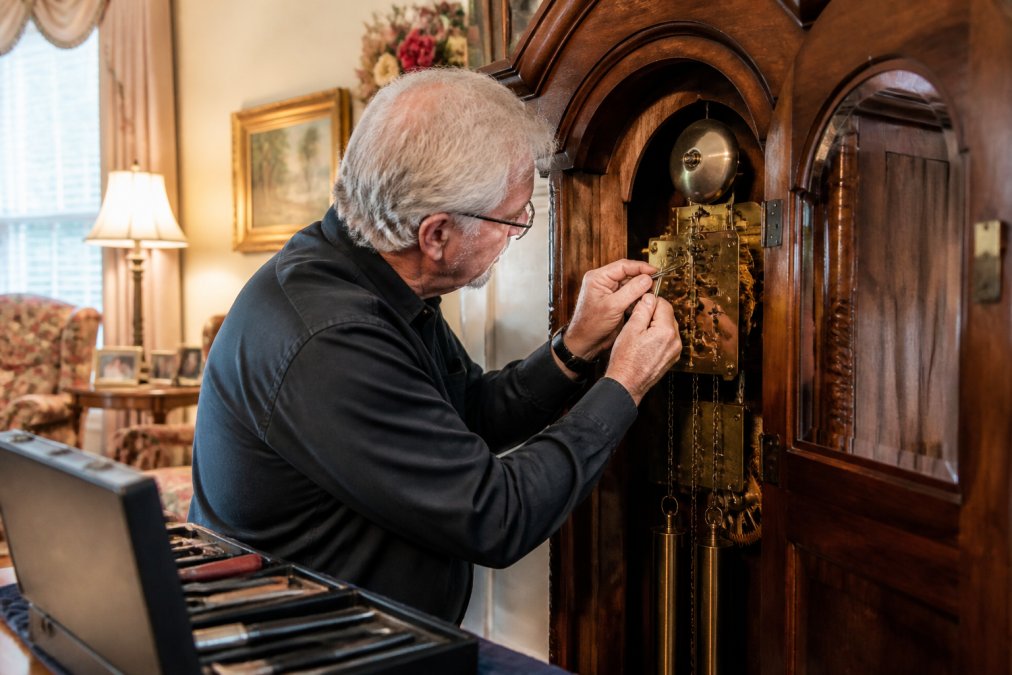
In-home service is the safest option for large, fragile clocks and standard practice for many antique floor clocks. The clockmaker arrives with tools, examines the movement in place, and performs what the location allows.
What to Expect During an On-Site Visit
A house call typically starts with a full assessment. The clockmaker will:
- Inspect the case, dial, and hands for damage or prior repairs
- Examine the movement for wear, dirt, and dried lubricant
- Check the pendulum and weights for correct setup
- Listen to the chime and strike sequence for synchronization problems
- Recommend whether the work can be done on-site or requires shop time
Types of Clocks Serviced and Common Repair Needs
A qualified clockmaker should handle the full range of mechanical timepieces, not just one style:
- Grandfather and grandmother floor clocks with weight-driven movements
- Mantle and shelf clocks, often spring-driven
- Cuckoo clocks, which combine movement repair with chime and figure mechanics
- Wall clocks and regulator clocks
- Antique pocket watches and vintage wristwatches
Antique and Vintage Timepiece Restoration
Restoration is different from repair. Repair makes a clock run; restoration returns it close to original condition while preserving its history, matching finishes, sourcing period-correct materials where possible, and resisting the urge to over-polish a dial that should show its age.
Your Grandfather Clock Maintenance Schedule
A grandfather clock rewards routine care. This schedule covers the tasks most owners can handle themselves and the ones that belong to a professional.
| Frequency | Task | Who Does It |
|---|---|---|
| Weekly | Wind the weights fully | Owner |
| Monthly | Check timekeeping accuracy against a reliable clock | Owner |
| Monthly | Listen for irregular chimes or strikes | Owner |
| Yearly | Inspect for dust, check pendulum level | Owner |
| Every 3-5 years | Full movement cleaning and oiling | Professional |
| As needed | Bushing, gear, or mainspring work | Professional |
Daily, Monthly, and Yearly Tasks
Daily care is minimal: let the clock run and keep the case out of direct sunlight and away from heating vents. Monthly, compare the time against a phone or computer and note any drift. A clock that loses or gains a few minutes a month may only need a pendulum adjustment; one that stops or stalls needs attention.
How to Oil a Grandfather Clock Safely
Oiling is the task owners most often get wrong, and the consequences are expensive: done correctly it extends a movement's life, done carelessly it accelerates wear.
Tools and Supplies You'll Need
- A clock-specific oil, not household lubricant
- A small oiler or fine applicator
- A soft brush for dust removal
- A lint-free cloth
- Good lighting and, ideally, a magnifier
Step-by-Step Oiling Process
- Stop the clock and let the pendulum come to rest. Never oil a running movement.
- Remove the weights and pendulum only if you are confident doing so safely. If not, stop here and call a professional.
- Dust the movement with a soft brush. Never blow on it; moisture from your breath causes corrosion.
- Locate the pivot points, the small holes where each gear's arbor passes through the plates.
- Apply a single small drop of clock oil to each pivot. More is not better.
- Wipe away any excess immediately with a lint-free cloth.
- Reassemble and restart, then check the beat and timekeeping over the next few days.
If the movement is dirty, oiling makes things worse by trapping grit against the pivots. It needs cleaning first, which is a workshop job.
Antique Clock Restoration Cost: What to Expect
Most owners hesitate to call a clockmaker for one reason: they have no idea whether the bill will land closer to a tune-up or a major repair. A shop that refuses to talk about money before an inspection is not doing you a favor. For pricing on your specific piece, contact the workshop directly with the clock's maker, approximate age, and a description of the symptoms, enough for a realistic range, even before an on-site visit.
Typical Price Ranges by Service
| Service | Typical Range | Notes |
|---|---|---|
| Diagnostic or house-call assessment | $75-$200 | Often credited toward the repair if you proceed |
| Basic oiling and adjustment (clean movement) | $150-$350 | Only appropriate if the movement is not worn |
| Full movement cleaning and lubrication | $400-$900 | Movement removed, disassembled, cleaned, re-oiled |
| Bushing replacement (per pivot) | $25-$75 each | Most worn movements need several |
| Mainspring replacement | $75-$200 per spring | Spring-driven clocks only |
| Gear or wheel fabrication | $150-$500+ | Depends on complexity and whether a pattern exists |
| Dial restoration | $200-$800+ | Silvered, painted, and enameled dials price differently |
| Case refinishing or veneer repair | $300-$1,500+ | Often subcontracted to a furniture restorer |
| Full restoration of an antique floor clock | $1,500-$5,000+ | Combines movement, dial, and case work |
A clock that has sat silent for a decade often requires more extensive work than basic oiling. Oiling alone on a dirty movement can accelerate wear.
What Drives the Number Up or Down
- Number of trains. A time-only movement has one gear train. Add chime and strike and you have three, which roughly triples the pivot count and the labor.
- Condition on arrival. Rust, dried grease, and prior bad repairs (especially epoxy or household oil) all add hours of cleanup.
- Parts availability. A catalog replacement is cheap. A gear that has to be cut from scratch is not.
- Whether the clock stays in your home. On-site work avoids crating and transport but limits what can be done. Shop work is more thorough but adds handling risk and time.
- Turnaround time.
How to Read an Estimate
Ask for a written estimate separating three line items: diagnosis, parts, and labor. A lump-sum number tells you nothing about where the money goes and makes comparing shops impossible. A reputable clockmaker will also tell you what they will not do, for example, refusing to over-polish an original dial, because that restraint protects the piece's value.
Why Phone Quotes Are Usually Wrong
A clockmaker who gives a firm price over the phone without seeing the movement is guessing. The difference between a movement that needs oiling and one that needs several bushings is not visible from a description. Treat any phone number as a placeholder and any written estimate after inspection as the real starting point.
DIY Troubleshooting: When to Call a Professional
Most results for this search are pure sales pages. This section is not. Below is a real ten-minute diagnostic sequence, followed by the symptoms that mean you should stop and call a horologist. The goal is not to turn you into a clockmaker, it is to help you describe the problem accurately and avoid making it worse.
The Ten-Minute Diagnostic
Work through these in order. Stop as soon as you find the cause.
- Is the clock level? Place a spirit level on the top of the case, front to back and side to side. A floor clock that has shifted on carpet or hardwood will run fast, slow, or stall. Shim the feet until it is level.
- Are the weights fully wound? On a weight-driven clock, each weight should be near the top of its travel after winding. If a weight is sitting near the bottom of the case, the clock is simply run down.
- Is the pendulum in beat? Listen to the tick-tock. A healthy clock produces an even, metronome-like rhythm. If it sounds like tick… tock with a long pause on one side, the clock is out of beat and will stall. This is adjustable, but the adjustment is delicate, see the stop line below.
- Is the pendulum swinging freely? Check that it is not touching the back of the case, the weights, or a shelf. A pendulum that grazes anything will stop.
- Are the hands obstructed? A bent hand or a loose hand nut can cause the clock to stop at the same time every day. Note when it stops, that pattern is diagnostic.
- Has anything changed? A move, a new rug, a nearby HVAC vent, or a recent cleaning can all throw off a clock that was running fine.
Symptoms You Can Safely Address Yourself
- Clock runs fast or slow by a few minutes a week. Adjust the pendulum rating nut, the small nut under the pendulum bob. Turning it up speeds the clock; turning it down slows it. Make a quarter-turn at a time and re-check after 24 hours.
- Clock stopped after being bumped. Re-level the case and restart the pendulum. If it runs for a day and stops again, the problem is internal.
- Chime sounds at the wrong hour. On many movements the hour hand can be moved independently to re-sync the strike. Check your clock's manual before forcing anything.
- Dust on the case. A soft, dry cloth only. Never spray polish near an open movement.
Symptoms That Mean Stop and Call a Pro
- The clock is out of beat and you cannot correct it with the case level. Beat adjustment requires bending the crutch, and a wrong bend can damage the escapement.
- The clock runs for a few hours or days and then stops, repeatedly. This is the classic signature of worn pivot holes (ovaled bushings) or a tired mainspring. No amount of oiling fixes it.
- You hear grinding, scraping, or a snapping sound. Something is broken inside. Running the clock makes it worse.
- The chime or strike is out of sequence with the time. Re-syncing the strike train is a workshop job on most movements.
- The clock has not been serviced in five years or more. Even if it is running, the oil is likely dried and the pivots are wearing. Running it accelerates the damage.
- The movement is unfamiliar, unsigned, or clearly antique. Do not experiment on a piece you cannot replace.
- You are afraid to touch it. That instinct is usually correct. Trust it.
How to Describe the Problem When You Call
A clockmaker can give a far more useful answer if you arrive with specifics. Before you call, note:
- The maker's name and any serial number or stamp on the movement or dial
- The approximate age, if known
- Whether the clock is weight-driven or spring-driven
- Exactly what it does and does not do (runs but does not chime; chimes but loses time; stops at the same hour every day)
- When it was last serviced, if you know
- Whether it has been moved recently
Frequently Asked Questions
How often should a grandfather clock be serviced?
Most grandfather clocks need professional servicing every 3 to 5 years. During a service, a horologist will clean the movement, oil the pivots, check the pendulum adjustment, and inspect for worn bushings or gears. If your clock runs fast or slow, chimes at the wrong time, or stops unexpectedly, schedule a service sooner. Regular maintenance prevents costly repairs and keeps your timepiece accurate.
Are grandfather clocks hard to fix?
Grandfather clocks are complex mechanical devices, and repairs require specialized knowledge of weight-driven or spring-driven movements. While minor issues like pendulum adjustment or oiling can be DIY, problems with the movement, chime synchronization, or gear repair should be handled by a professional horologist. Attempting major repairs without training can cause further damage and reduce the clock's value.
Can I move a grandfather clock by myself?
Moving a grandfather clock alone is risky. These clocks are tall, heavy, and fragile. Always remove the weights and pendulum first, secure the chains, and have at least two people to lift and carry the clock. Never tilt it more than 30 degrees. For long-distance moves, hire a professional clock mover who understands antique timepieces. Improper handling can damage the movement, dial, or case.
What are the most common problems with grandfather clocks?
Common issues include worn bushings, broken mainsprings, dirty movements, and pendulum misalignment. Chime synchronization problems and weight-driven cable failures are also frequent. Environmental factors like humidity and temperature changes can cause wood swelling or contraction, affecting the clock's operation. Regular maintenance and prompt attention to odd sounds or irregular timekeeping can prevent major repairs.