

Table of Contents
- Step 1: Assess the Antique Clock's Condition Before Touching It
- Step 2: Safe Handling and Storage of Fragile Clock Components
- Step 3: How to Clean an Antique Clock Without Damaging It
- Step 4: Disassembly, Movement Components, and Keeping Parts Organized
- Step 5: Antique Clock Oil and Lubrication Done Right
- Common Antique Clock Repair Mistakes to Avoid
- When to Hire a Clock Restorer for Your Antique Clock
- Conclusion: Preserving Your Antique Clock for the Next Generation
- Frequently Asked Questions
Last Updated: October 7, 2026
Step 1: Assess the Antique Clock's Condition Before Touching It
The first rule of how to restore fragile antique clocks is simple: look before you touch. At Josef & Joseph, 30-plus years of handling heirloom timepieces has taught us that most damage comes from owners who clean before they understand what they are working with.
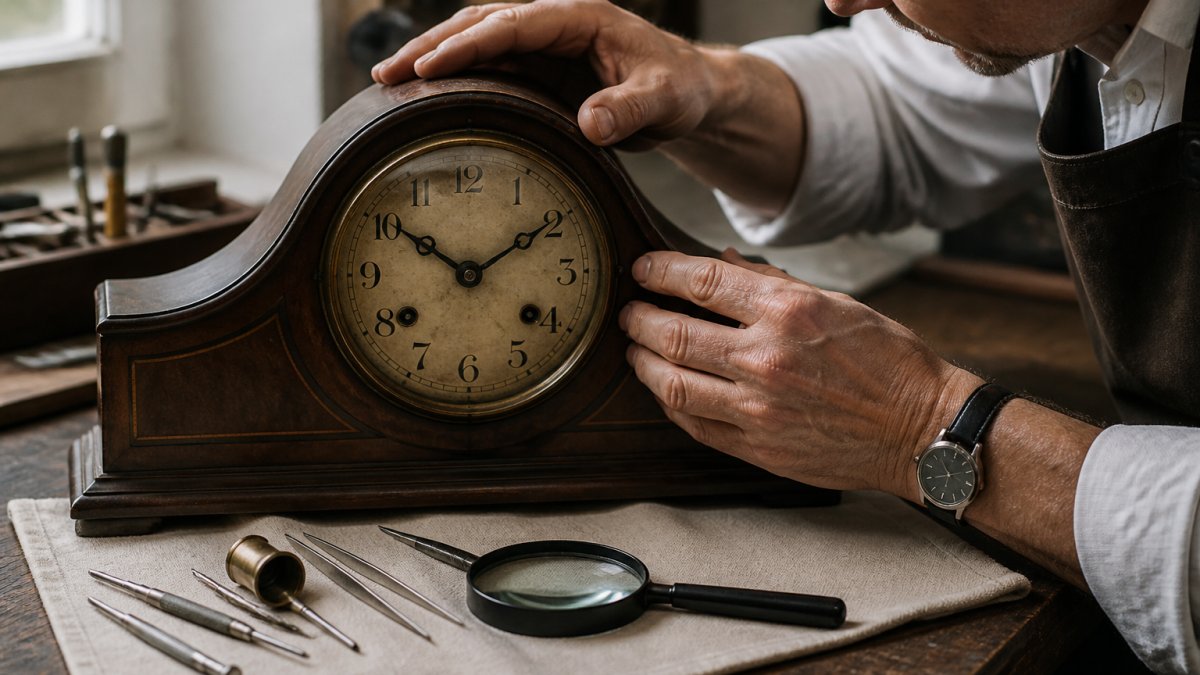
Start with a slow, careful inspection:
- Note the clock's overall condition, inside and out
- Check whether the clock case is wood, metal, or painted
- Look for cracks in the clock face, glass, or veneer
A vintage clock that has not run in decades hides rust, cracked pivots, and dried oil, none of which improve with a rushed repair.
The Triage Checklist: When to Stop and Call a Professional
Some clocks should never be opened by an amateur. Use this checklist to decide whether to stop:
- The clock face is painted or signed by the maker
- The movement has rust, corrosion, or a broken mainspring
- The case shows active woodworm, mold, or water damage
If you checked even one box, stop. According to the Smithsonian's guidance on caring for antique objects, fragile historic pieces are best handled by trained conservators. A clockmaker with restoration training can assess the clock movement without causing further harm. For large grandfather clocks, on-site service avoids the risk of transport damage entirely.
Step 2: Safe Handling and Storage of Fragile Clock Components
Most damage to antique clocks happens during moving, not repair. Wear cotton gloves, support the case from the bottom, and never lift a clock by its dial, hands, or pendulum.
Before restoration, store the clock in a dry room with steady temperature:
- Lay large clocks flat or keep them upright in a padded crate
- Wrap loose pendulums and weights in acid-free tissue
- Keep small parts in labeled trays, never loose in a bag
Mainspring Safety and Stored Energy
A mainspring holds stored tension even when a clock stops, and that energy can release instantly. Never open a mainspring barrel without a let-down tool and training, a released spring can bend pivots and crack wheels, turning a cleaning into a full rebuild.
Step 3: How to Clean an Antique Clock Without Damaging It
Cleaning an antique clock is where good intentions cause the most harm: harsh chemicals strip original finishes and water ruins wood veneer. Stay dry, gentle, and slow.
For general dust and dirt:
- Use a soft brush and a vacuum with a brush attachment on low
- Wipe wood cases with a dry or barely damp cloth, then dry at once
- Clean glass with a lint-free cloth, never a spray aimed at the dial
Material-Specific Cleaning: Painted Dials, Silvered Dials, and Wood Cases
Different materials need different care: a painted dial can lose its artwork with one wrong swipe, a silvered dial tarnishes and scratches easily, and wood cases hold their patina in the finish.
| Material | Safe Approach | Avoid |
|---|---|---|
| Painted dial | Dry soft brush only | Water, solvents, rubbing |
| Silvered dial | Leave to a clockmaker | Polishes, abrasive cloths |
| Wood case | Dry cloth, wax-free | Wet rags, furniture spray |
| Brass parts | Dry cloth, light care | Acid dips, harsh polish |
Step 4: Disassembly, Movement Components, and Keeping Parts Organized
Disassemble only after assessment and only with the right tools. The movement holds dozens of small parts, so photograph each layer before removing anything, a wide shot of the assembled movement, then one per layer, so reassembly follows the record, not memory.
How the Movement Actually Works
A mechanical clock is a power train that releases energy at a controlled rate. Understanding the flow tells you which part to suspect when something fails.
- The mainspring or weight stores the energy. A wound mainspring holds that energy even when the clock is stopped.
- The gear train (wheels and pinions) steps that energy up through a series of gears, from the slow, powerful first wheel to the fast, lightly loaded escape wheel.
- Pivots are the polished ends of each arbor that ride in tiny holes or jewels in the plates. Worn pivots and ovaled pivot holes are a leading cause of poor timekeeping and stopping.
Symptom-Based Troubleshooting Before You Disassemble
Match the symptom to the likely cause before opening anything.
| Symptom | Likely Cause | First Check |
|---|---|---|
| Clock stops after a few minutes | Out of beat, weak impulse | Crutch loop position, suspension spring |
| Runs fast or slow consistently | Pendulum length or suspension spring | Bob height, spring condition |
| Stops at the same point each time | Bent pivot, damaged tooth, or debris | Escape wheel teeth, pivot holes |
| Hands will not move | Motion-work friction clutch or jammed dial train | Cannon pinion, minute-wheel friction |
| Ticks unevenly or double-ticks | Escapement out of adjustment | Anchor pallets, crutch |
| Loses time only when striking | Strike train robbing power | Warning lever, strike train friction |
If a symptom points to a bent pivot, cracked wheel, or broken suspension spring, stop, those repairs need a lathe, depthing tool, or jeweling setup, and forcing them by hand causes more damage than the original fault.
Keeping Parts Organized
Keep every screw, pin, and spring in a labeled tray. A missing part on a vintage clock can mean months of custom fabrication. Josef & Joseph regularly makes parts that no longer exist, but organizing as you go saves that trouble.
- Use a compartmented tray with one slot per subassembly: time train, strike train, motion work, dial, case hardware.
- Bag and label screws by location, thread pitches on antique clocks are not standardized, and a swapped screw can strip a plate.
- Photograph each subassembly on the tray before moving on.
Step 5: Antique Clock Oil and Lubrication Done Right
Antique clock oil is not general machine oil: it stays put under light load, resists gumming, and protects small pivots without creeping onto gear teeth. Using the wrong oil, or the right oil in the wrong place, is one of the costliest mistakes in clock care. Precision lubrication remains equally vital when maintaining mechanical watches, where the delicate balance between friction reduction and oil migration determines the longevity of the movement.
Why Old Oil Stops a Clock
Clock oil oxidizes over time into a sticky varnish that grips pivots instead of lubricating them, so the movement fights drag and runs slow, stops at the same point, or refuses to run. Fresh oil over that residue makes it worse, clean the old oil out first.
Where Clock Oil Actually Goes
Oil belongs only at the pivot points, where an arbor turns in its hole or jewel. Everywhere else, oil attracts dust and creates grinding paste.
- Pivot holes in the plates, the primary oiling points, one drop of clock oil per pivot.
- Escape wheel pivots, lightly oiled, because the escapement runs under very low load.
- Cannon pinion and motion-work friction points, a trace of oil or grease, depending on the design.
Do not oil:
- Gear teeth or pinion leaves, oil there collects dust and wears the teeth.
- The escapement pallets and escape wheel teeth, these run dry by design.
- The suspension spring, oil stiffens it and changes the rate.
Choosing the Right Lubricant
Most practitioners find a synthetic clock oil with a viscosity near light sewing-machine oil works well on antique pivot points: heavier oils damp the escapement, lighter oils migrate off the pivot. Avoid general-purpose oils such as 3-in-1, WD-40, and automotive lubricants, they are not formulated for a clock's slow speeds and tiny loads, and some contain solvents that attack shellac and lacquer finishes on the plates.
How Much and How Often
- Use a fine oiler, a wire needle with a small reservoir, not a squeeze bottle.
- Apply one small drop per pivot. If oil runs down the plate, you used too much; wipe it off with a lint-free cloth.
- Re-oil roughly every three to five years for a clock in regular use. A clock that has not run in decades needs cleaning before any oil is added.
Common Antique Clock Repair Mistakes to Avoid
Most antique clock repair mistakes come from speed and guesswork. The most common:
- Spraying chemical cleaner into the movement
- Forcing stiff hands or gears to move by hand
- Replacing original parts with modern ones
Each of these can turn a small repair into a major restoration. The National Park Service's conservation guidelines stress minimal intervention: do as little as possible, and do it carefully.
When to Hire a Clock Restorer for Your Antique Clock
Hire a clock restorer when the work involves the movement, the dial, or anything you cannot undo. Cleaning a wood case is a homeowner task. Rebuilding an escapement is not.
Signs it is time to call a professional:
- The clock will not run after basic care
- You see rust, broken springs, or bent pivots
- The dial is painted, signed, or historically important
A trained clockmaker has the precision tools, microscope, and experience to work on delicate components without harm. For large grandfather clocks, house call services let the work happen on site, so the clock never travels.
Conclusion: Preserving Your Antique Clock for the Next Generation
Caring for an antique clock is really about restraint. The owners who preserve these pieces best know when to stop and who to call. If your clock needs more than gentle dusting, do not risk it.
At Josef & Joseph, every clock restoration is done by hand by Josef, backed by over 30 years of European master training. We revive complex, vintage, and heirloom pieces that other shops decline, fabricate parts that no longer exist, and offer safe on-site service for large, fragile clocks.
Frequently Asked Questions
What is the safest way to clean a fragile antique clock?
Start by dusting with a soft, dry brush or microfiber cloth. Never use water, ammonia, or chemical cleaners on painted or silvered dials, as they can remove original finishes. For wood cases, a slightly damp cloth with mild soap is usually safe, but test on a hidden spot first. The clock movement itself should only be cleaned with proper clock-cleaning solutions and precision tools. If the dial is flaking or the case has loose veneer, stop and consult a professional clock restorer before attempting any cleaning.
What is the best antique clock oil, and can I use WD-40 instead?
Use a clock-specific oil, such as a synthetic clock oil recommended for antique movements. These oils are designed to stay stable and not gum up over time. Never use WD-40 or general-purpose lubricants on an antique clock. WD-40 is a solvent, not a lubricant, and it will dissolve the original oil, attract dust, and accelerate wear on pivots and gears. Applying the wrong oil is one of the most common antique clock repair mistakes and can lead to costly damage.
Should I wind an antique clock that has not run for years?
Do not wind it immediately. A clock that has sat unused for years may have dried oil, rusted pivots, or a weakened mainspring. Winding it can cause sudden tension that snaps the mainspring or damages the escapement. First, inspect the movement for obvious corrosion or broken parts. If the clock is valuable or fragile, have a clockmaker assess it before applying any power. If you must test it, wind only one or two turns and listen for unusual sounds, then stop if anything feels wrong.
How can you tell if an antique clock needs professional restoration?
Signs include a broken or missing suspension spring, a bent crutch, cracked or flaking dial paint, rust on pivots or gears, a mainspring that will not hold tension, or a clock that stops repeatedly after winding. If the case has structural damage or the movement has missing parts, professional help is essential. A clock restorer can fabricate parts that no longer exist and clean the movement properly. When in doubt, a no-commitment consultation is better than risking further damage to a fragile antique clock.