

Table of Contents
- What a GIA Certified Diamond Appraisal Actually Tells You
- GIA Diamond Grading Report vs Appraisal: Why You Need Both
- How to Identify Authentic Heirloom Jewelry Before Your Appointment
- What to Expect During a Professional Appraisal Appointment
- Jewelry Appraisal Cost: What Drives the Price
- How to Choose a Qualified Gemologist in Fort Lauderdale
- Red Flags of Fraudulent Appraisals and How to Avoid Them
- Frequently Asked Questions
Last Updated: October 1, 2026
What a GIA Certified Diamond Appraisal Actually Tells You
A GIA certified diamond appraisal is a written valuation of your diamond or jewelry, prepared by a qualified professional. The report states what your piece is worth for a specific purpose, such as insurance or resale. It does not grade the diamond itself.
That last point trips up a lot of people. A diamond appraisal is not the same as a diamond grading report. One sets a dollar value. The other describes the stone.
At Josef & Joseph, we have handled restorations and custom work for South Florida families since 1991.
The Difference Between a Grading Report and an Appraisal
A GIA diamond grading report describes a diamond's quality. It lists the 4Cs: carat weight, color grade, clarity grade, and cut quality. It also notes measurements, fluorescence, and any treatments. The Gemological Institute of America's grading standards explain how each of these is measured in a controlled lab.
GIA Diamond Grading Report vs Appraisal: Why You Need Both
You need both because they do different jobs, and most insurers want the pair. The grading report proves what the stone is. The appraisal proves what it would cost to replace.
Here is how the two documents compare:
| Feature | GIA Grading Report | Jewelry Appraisal |
|---|---|---|
| Purpose | Identifies diamond quality | Assigns dollar value |
| Who issues it | GIA laboratory | Independent appraiser |
| Includes price | No | Yes |
| Uses 4Cs analysis | Yes, primary focus | Yes, as a basis |
| Needed for insurance | Helpful | Required |
| Typical lifespan | Permanent for the stone | 2-3 years before update |
How to Identify Authentic Heirloom Jewelry Before Your Appointment
Start by looking for marks, not by cleaning the piece. Old jewelry carries small stamps that tell you where and when it was made. Those marks are the fastest way to spot a genuine heirloom.
- Hallmarks show the metal purity and the maker
- Maker's marks identify the workshop or brand
- Date letters can narrow down the year of production
- Signatures on fine pieces confirm the designer
Hallmarks, Signatures, and What They Reveal
Hallmarks are official stamps that confirm the metal content of a piece. In the United States, you will often see "14K," "18K," or "925" for sterling silver. Older European pieces may carry different symbols entirely.
What to Expect During a Professional Appraisal Appointment
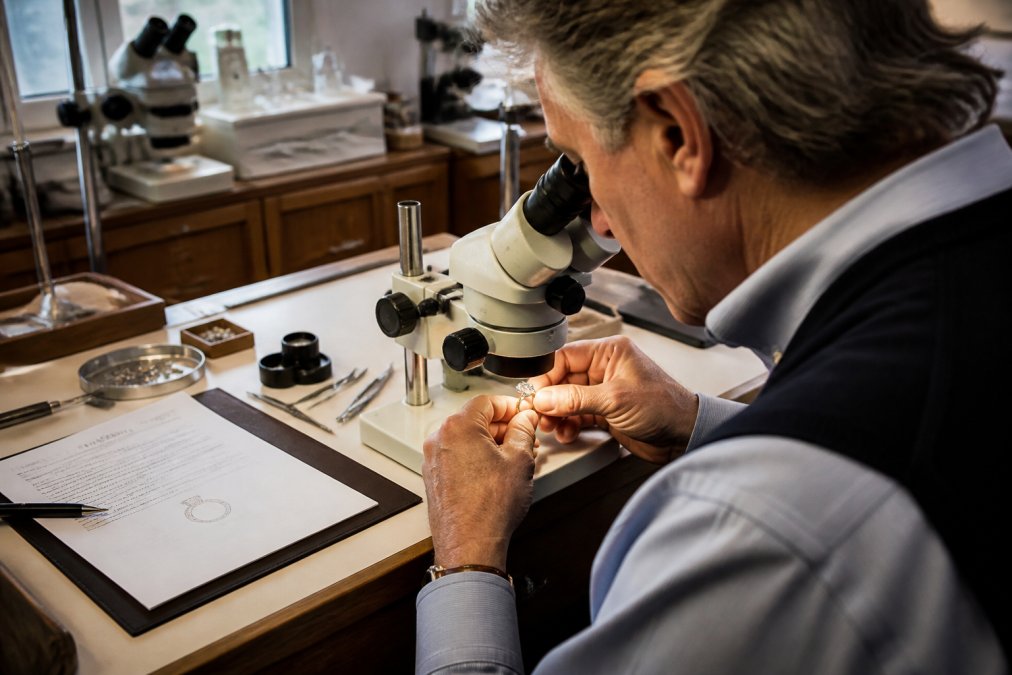
Expect a careful, hands-on examination that takes time. A proper appraisal is not a quick glance under a lamp. The appraiser will measure, weigh, and photograph your piece, then document everything in writing.
The Step-by-Step Appraisal Process
- Intake and documentation. The appraiser logs your piece and notes its condition.
- Visual inspection. A loupe or microscope check reveals the stone's features.
- Measurement. The appraiser records carat weight, plus table and depth percentages.
- Metal testing. Precious metals are tested for purity and hallmarks.
- Market research. The appraiser checks current market trends for comparable pieces.
- Report writing. Findings and a dollar value go into the final document.
You should leave with a written appraisal report you can hand straight to an insurer. If a shop cannot give you that, walk away.
Jewelry Appraisal Cost: What Drives the Price
Jewelry appraisal cost depends on the piece, not a flat rate. A single diamond solitaire takes less time than a full estate collection. That difference shows up in the fee.
How Appraisers Actually Price the Work
There are three common fee structures, and knowing which one you are being quoted helps you compare apples to apples:
- Flat per-item fee. A single ring or pendant is quoted at one price regardless of how long the exam takes. This is the most predictable for the customer and the most common for straightforward solitaires.
- Hourly rate. The appraiser bills for time spent on intake, examination, market research, and report writing. This is typical for estates, multi-piece collections, and complex vintage work where the scope is unknown until the piece is in hand.
- Tiered or per-stone pricing. A base fee for the first item, then a reduced rate for each additional piece in the same appointment. Useful when you are bringing in a full jewelry box.
What Moves the Number Up or Down
- Number of items in the appointment
- Complexity of the piece and its settings, including invisible-set, pavé, or multi-stone work
- Whether lab grading is needed first, since a GIA submission is a separate cost and timeline
- Report type, since insurance replacement, estate, and equitable distribution appraisals require different research and language
- Turnaround time, if you need it rushed
- Metal testing and stone identification when the piece has no hallmarks or the stones are unverified
A Practical Way to Budget
Because fees vary by market and by appraiser, the honest answer is that you should ask for a written quote before any work begins. A few patterns hold across most markets:
- A single diamond ring appraisal is usually the least expensive category.
- A multi-piece estate or collection appraisal is usually billed hourly or on a tiered schedule, so the total scales with volume.
- If lab grading is required first, expect that as a separate line item with its own timeline.
How to Choose a Qualified Gemologist in Fort Lauderdale
Look for credentials first, then ask about process. A qualified gemologist holds formal training and can explain how they reach a value. Anyone can print a certificate. Fewer can defend the number on it.
The Credentials That Actually Mean Something
Gemological credentials come from a small number of recognized programs. The most widely recognized is the Graduate Gemologist (G.G.) diploma from the Gemological Institute of America, which requires completing coursework in diamonds and colored stones plus hands-on lab classes. Other recognized paths include the American Gem Society's Registered Gemologist Appraiser and independent titles from the International Gemological Institute.
A Verification Framework, Not Just a Questionnaire
For each answer, ask yourself: how would I confirm this independently?
- Credentials. Ask for the credential number or diploma reference, then verify it through the issuing organization's public directory or by contacting the organization directly. Do not accept a photocopy as proof.
- Tools. Ask whether the exam uses a binocular microscope, a master set of color comparison stones, a calibrated scale, and a refractometer. A loupe alone is not a lab-grade exam.
- Independence. Ask directly whether the appraiser or the firm buys, sells, or consigns jewelry. If yes, ask how they separate the two functions. The cleanest answer is that they do not appraise pieces they are also trying to buy.
- Report samples. Ask to see a redacted sample report. Look for photos, measurements, method notes, and a stated purpose. A one-page letter with a number and no evidence is a warning sign.
- Insurance acceptance. Ask which insurers have accepted their reports in the past. A report format that insurers routinely reject is not useful to you.
The Independence Question, Answered Properly
An independent appraiser has no financial stake in the value they assign. That does not mean a retail jeweler can never appraise, but it does mean the incentive structure matters. If the same person is buying and valuing your piece, get a second opinion.
Questions Worth Asking Before You Commit
- What professional credentials do you hold, and how can I verify them?
- Do you use a microscope and lab-grade tools?
- How do you handle insurance valuation versus resale value?
- Can you show examples of past appraisal reports?
- Are you independent, or do you also sell jewelry?
- Will you put your independence statement in writing?
Red Flags of Fraudulent Appraisals and How to Avoid Them
Fraud in appraisals rarely looks dramatic. It usually shows up as a vague report with a big number and no backup. That inflated figure can cost you later when an insurer disputes a claim.
Watch for these signs:
- No credentials listed anywhere on the report
- A value with no method or comparables explained
- No photos or measurements of the piece
- Pressure to sell on the spot
- A fee that is a percentage of the appraised value
Frequently Asked Questions
How much does a GIA certified diamond appraisal cost?
Jewelry appraisal cost depends on the number of pieces, the complexity of the settings, and whether the gemologist needs to remove stones for accurate grading. A single diamond ring typically takes less time than an entire estate collection.
Can appraisers tell if a diamond is lab grown?
Yes. A trained gemologist uses microscope inspection and specialized equipment to identify lab-grown diamonds. Lab-grown stones often show specific growth patterns and fluorescence reactions that natural diamonds do not.
Why is a GIA report important for insurance purposes?
Insurance companies require documentation that establishes the replacement value of your jewelry. A GIA diamond grading report provides an independent, recognized assessment of the 4Cs: carat weight, color grade, clarity grade, and cut quality. This report, combined with a professional appraisal, gives your insurer the information needed to set accurate coverage and process claims without dispute.
How often should I have my heirloom jewelry appraised?
Most insurance policies recommend updating your appraisal every two to three years, or whenever market trends shift significantly. You should also get a new appraisal after any repair, resetting, or significant change to the piece. For estate jewelry or pieces with historical value, more frequent updates may be wise to ensure your coverage keeps pace with current fair market value.