

Table of Contents
- What Makes a No-Commitment Consultation Truly Transparent
- How to Identify Authentic Heirloom Jewelry
- Questions to Ask a Jeweler Before Restoration
- Heirloom Jewelry Restoration Cost Estimate: What to Expect
- Digital vs. In-Person Consultations for Heirloom Jewelry Restoration
- Insurance and Liability During the Restoration Process
- Checklist for Evaluating a Jeweler's Portfolio
- Frequently Asked Questions
Last Updated: September 28, 2026
What Makes a No-Commitment Consultation Truly Transparent
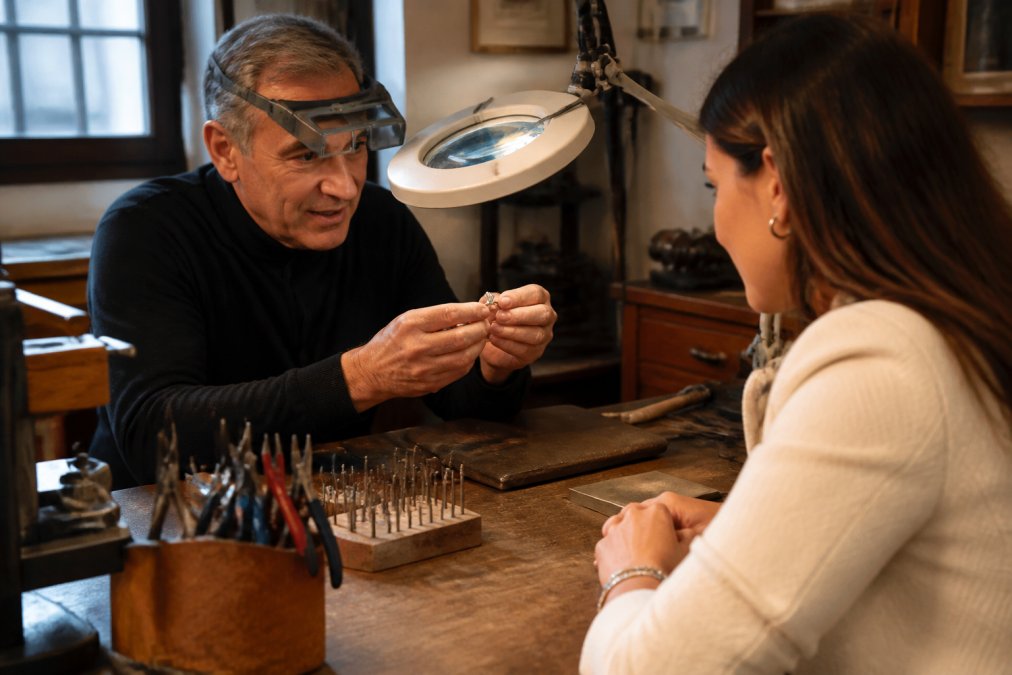
- A hands-on inspection, not a glance from across the counter
- A written estimate that itemizes each repair separately
- A clear explanation of what happens if the jeweler finds hidden damage mid-repair
- Zero obligation to proceed once the estimate is in your hands
Many jewelers in the trade treat a free estimate as a loss leader. The honest ones treat it as the first test of whether the relationship will work.
How to Identify Authentic Heirloom Jewelry
Authentic heirloom jewelry is a piece with documented family history or verifiable antique provenance, typically showing hand-fabricated construction methods that predate modern mass production. Age alone doesn't make something an heirloom.
- Hand-cut settings. Old stones sit in seats cut by hand, often slightly irregular. Perfectly uniform prongs usually signal modern manufacturing.
- Unmarked or hand-engraved metal. Early pieces often carry no hallmark at all, or a stamp applied by hand rather than machine.
- Worn solder joints. Genuine age shows in the joins. Look for slight discoloration where pieces were assembled decades ago.
- Family documentation. Photographs, insurance riders, or a handwritten note from a grandparent carry more weight than any test.
Questions to Ask a Jeweler Before Restoration
The single most useful question to ask before any restoration is: "What could go wrong during this repair, and what happens if it does?" A jeweler who answers that honestly is worth your business.
Other questions worth asking, in roughly this order:
- Who actually does the work? Some shops send pieces out. Ask whether the repair happens in-house.
- Can I see examples of similar work? A jeweler who has restored pieces like yours should be able to show you.
- What's the repair turnaround? Vague answers usually mean the piece sits in a queue.
- Is the estimate itemized? You want stone tightening, rhodium plating, and ring resizing listed separately, not bundled into one number.
- What's the service guarantee? Ask specifically what happens if a stone loosens after you get the piece back.
- Will you test the metal before quoting? Precious metals vary, and a quote built on an assumption is not a quote.
Heirloom Jewelry Restoration Cost Estimate: What to Expect
A heirloom jewelry restoration cost estimate should break down each service, explain why it's needed, and flag anything that might change the final number. The total depends on the piece, not on a flat rate.
What a Consultation Should Cost
A genuinely no-commitment consultation is almost always free or low-cost, and the structure tells you a lot about the shop:
- Free in-person assessment. The standard for most full-service shops. You bring the piece in, a jeweler inspects it under magnification, and you leave with a written estimate. No deposit.
- Paid diagnostic, credited back. Some shops charge a modest diagnostic fee for complex pieces, think antique movements, multi-stone settings, or pieces requiring disassembly to assess. The reputable version of this credits the fee toward the repair if you proceed.
- Paid appraisal, separate from repair. If you need a documented valuation for insurance rather than a repair quote, that's a different service with its own fee. Don't let a shop blur the two.
How the Estimate Is Built
What a legitimate estimate typically includes:
- Damage assessment. A written description of what's worn, cracked, loose, or missing.
- Line-item pricing. Each repair listed with its own cost, stone tightening, prong rebuilding, rhodium plating, and resizing quoted separately, never bundled into one number.
- Contingency language. What happens if the jeweler uncovers hidden damage during the work.
- Timeline. An estimated repair turnaround, in writing.
- Exclusions. What the estimate does not cover.
The Variables That Move the Number
Two pieces that look identical on a counter can require completely different work. The cost drivers are consistent across the trade:
- Metal testing. A quote built on an assumed karat is not a quote. The jeweler should test before pricing.
- Setting condition. Tightening an existing prong is a different job than rebuilding a shattered setting on a fragile antique.
- Part fabrication. If a clasp, hinge, or stone seat no longer exists, someone has to make it by hand. That labor is the single biggest swing factor.
- Stone risk. Old stones can be brittle. A jeweler who won't discuss the risk of a stone cracking during a reset is not being straight with you.
Why Some Shops Won't Publish Flat Pricing
A shop that publishes a flat "restoration starts at" number is either quoting the simplest possible job or planning to revise upward once it has your piece. Neither is transparent. The honest version is an estimate built from the inspection, shown to you before you commit to anything, which is exactly what a no-commitment consultation is for.
Digital vs. In-Person Consultations for Heirloom Jewelry Restoration
In-person consultations remain the standard for heirloom work because a jeweler needs to handle the piece, test the metal, and examine settings under magnification. Digital consultations work well as a first step, especially for clients who live far from the shop.
| Consultation Type | Best For | Limitations |
|---|---|---|
| In-person | Fragile pieces, complex movements, final estimates | Requires travel to the shop |
| Video call | Initial screening, out-of-area clients, general questions | Cannot test metal or inspect settings closely |
| Photo review | Rough ballpark before committing to travel | Easily misses hidden damage |
The Remote Workflow Most Guides Skip
If you're not near a shop you trust, the real question isn't whether remote consultation works, it's how to get your heirloom there and back without losing it. Here's the sequence that protects both the piece and your wallet:
- Screen first, ship second. Start with photos and a video call. Send clear, well-lit images from multiple angles, plus any documentation you have, old appraisals, insurance riders, family notes. A jeweler can usually tell you from photos whether the piece is worth shipping.
- Get the shipping terms in writing before you box anything. Ask who insures the piece in transit, who pays for shipping each direction, and what happens if it's lost or damaged en route. The answer should be in writing, not a verbal assurance.
- Insure for appraised value, not purchase price. If you have a recent appraisal, that's the number the shipment should be insured against. If you don't, ask the jeweler how they handle valuation for transit.
- Ship signature-required, and track it. Overnight, signature-required, with the tracking number shared with the shop before the piece arrives. This is standard practice for anything of value.
- Confirm receipt in writing. A reputable shop will confirm the piece arrived and describe its condition on arrival, ideally with photos, before any work begins.
- Get the estimate before authorizing work. The remote workflow should end the same way the in-person one does: with a written, itemized estimate and no obligation to proceed.
What Remote Consultation Cannot Do
For clients outside the immediate area, the sensible workflow is a photo or video consultation first, followed by an in-person inspection before any work begins. That two-step approach protects the piece and saves everyone time, and it's the same discipline a good shop applies whether you walk in the door or ship across the country.
Insurance and Liability During the Restoration Process
Insurance and liability during restoration should be settled in writing before the jeweler takes possession of your piece. Ask what coverage applies while the item is in the shop, and get the answer in writing.
Three things to confirm:
- Coverage while in the shop. Does the jeweler carry insurance that covers your piece while it's in their custody?
- Appraised value. If you have a recent jewelry appraisal, bring it. It establishes the value the piece is insured against.
- Your own policy. Check whether your homeowner's or renter's policy covers items in transit or at a repair shop. Many do, with limits.
Checklist for Evaluating a Jeweler's Portfolio
Use this checklist during your consultation:
- Before-and-after photos of antique restoration work, not just new custom pieces
- Evidence of in-house workshop capability, not outsourced repairs
- Examples of custom fabrication for parts that no longer exist
- References or reviews from clients with similar pieces
- Clear explanation of their process, start to finish
- Written service guarantee
- Willingness to answer questions without rushing you
Josef & Joseph's own portfolio spans more than three decades of European master training across Austria, Switzerland, and Germany, with every piece handled by hand. That's the kind of track record you're trying to verify when you review anyone's work.
Frequently Asked Questions
How much does heirloom jewelry restoration cost?
Costs vary widely based on the piece's condition, materials, and complexity. A simple ring resizing costs less than fabricating a missing part for an antique brooch. Reputable jewelers provide a detailed quote after examining the item in person or via high-resolution photos. Josef & Joseph offers no-obligation estimates so you can decide before committing. Always ask for a written breakdown of labor, materials, and timeline.
What should I look for in a jewelry restoration consultation?
Look for a jeweler who examines your piece under magnification, explains the restoration process in plain language, and provides a written estimate with no pressure to proceed. They should ask about the piece's history and your goals. A transparent consultation includes a damage assessment, discussion of options, and clear pricing. Avoid any shop that rushes you or refuses to put the quote in writing.
How do I know if a jeweler is qualified to handle antique heirlooms?
Ask about their training, years of experience, and specific experience with pieces similar to yours. Request examples of past work, especially complex restorations. A master jeweler with European training, like Josef at Josef & Joseph, can fabricate parts that no longer exist. Check if they have an in-house workshop, offer a service guarantee, and can explain how they preserve metal integrity and gemstone settings.
Are no-commitment jewelry consultations common in the industry?
They are becoming more common as customers demand transparency. Many reputable jewelers now offer free or low-cost consultations with no obligation to proceed. This allows you to get a detailed quote and assess the jeweler's expertise before committing. Always confirm beforehand that the consultation is truly no-commitment and that you will receive a written estimate. Josef & Joseph provides this as standard practice.