

Table of Contents
- Custom Engagement Ring Design in Fort Lauderdale: Where to Begin
- The Step-by-Step Custom Ring Design Process
- Diamond, Gemstone, and Center Stone Selection
- Custom Engagement Ring Cost: What Drives the Price
- Custom Engagement Ring Timeline: From First Meeting to Delivery
- Custom vs. Ready-Made Engagement Rings: Which Fits Your Budget and Style
- Questions to Ask a Custom Jeweler Before You Commit
- Aftercare, Warranties, and Protecting Your Ring
- Frequently Asked Questions
Last Updated: October 6, 2026
Custom Engagement Ring Design in Fort Lauderdale: Where to Begin
A custom engagement ring is designed and built from scratch around a specific center stone, setting, and style rather than selected from existing inventory. For couples in South Florida, custom engagement ring design Fort Lauderdale offers a way to create something that exists nowhere else.
At Josef & Joseph, our workshop has handled bespoke jewelry since 1991, with over 30 years of European master training behind every piece. You control the stone, the metal, the proportions, and the details.
Below, we break down the design process, stone selection, cost drivers, timelines, and the questions that separate a smooth project from an expensive mistake.
The Step-by-Step Custom Ring Design Process
The custom process moves through six stages: consultation, sketch, 3D design, stone selection, casting and setting, and final finishing. Each stage lets you adjust before the next one locks in.
Here is how we run it:
- Consultation (in person or by phone): We discuss style, budget, and the story behind the piece.
- Sketching: Hand-drawn concepts translate your references into an actual design.
- 3D design and rendering: You see the ring from every angle before any metal is cut.
- Stone selection: We source diamonds or gemstones that match your budget and proportions.
- Casting and setting: The ring is cast, the center stone is set by hand, and details are refined.
- Finishing and delivery: Final polish, quality check, and handoff.
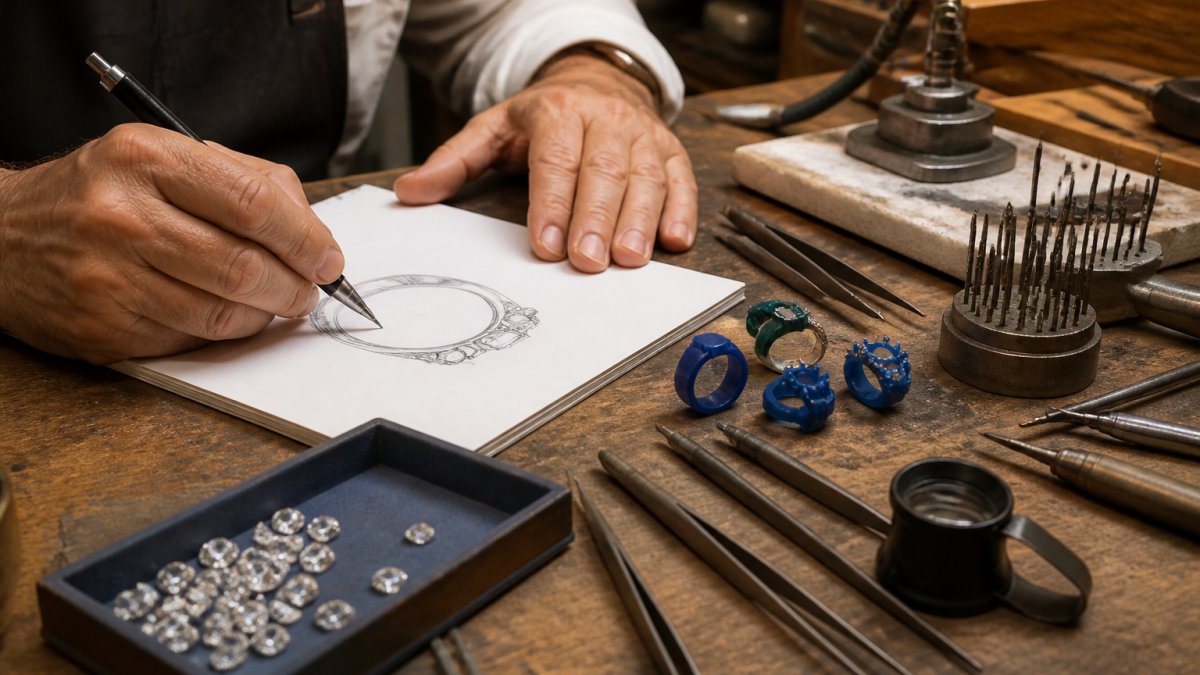
The 3D stage catches most surprises. A design that looks right on paper can feel off-balance in three dimensions. We show the render before casting so changes stay cheap.
From Consultation and Sketch to 3D Design and Casting
Sketches are fast and cheap; casting is not. That is why we front-load the visual decisions: by the time we commit to metal, you have approved the silhouette, setting style, and stone placement. If you have ever had a ring reset and watched a stone work loose months later, you know why the setting stage matters as much as the design.
Diamond, Gemstone, and Center Stone Selection
Center stone selection is where most of your budget lands and where the most confusion lives. The two main paths are natural and lab-grown diamond. Both are real diamonds with identical optical and physical properties; the difference is origin and price.
A few practical points:
- Natural diamonds carry a longer supply chain and higher price for the same carat weight.
- Lab-grown diamonds offer more size and clarity for the same budget.
- Colored gemstones (sapphire, ruby, emerald) can create a distinctive ring at a lower cost than a comparable diamond.
- Cut matters more than carat for how a stone actually performs in light.
The four Cs (cut, color, clarity, carat) still drive pricing, but for a custom ring, proportion relative to the setting matters just as much. A well-cut smaller stone in the right setting can outshine a larger, poorly proportioned one.
Custom Engagement Ring Cost: What Drives the Price
Custom engagement ring cost is driven by four factors: the center stone, the metal, design complexity, and labor.
1. The center stone (typically the largest line item). Stone cost scales with the four Cs, but not linearly.
2. The metal. Platinum and 18K gold cost more per gram than 14K gold, and the difference shows up in price and wear.
3. Design complexity. This is bench time, the hardest line to estimate up front. A plain solitaire is fast to build.
4. Setting type and labor. A four-prong solitaire is quicker to set than a bezel, tension setting, or three-stone design.
If you want a concrete reference point, our 14K White Gold Diamond Filigree Ring at $3,625.00 shows what a finished piece with roughly 0.60ct of round diamonds and an openwork filigree design looks like.

Custom Engagement Ring Timeline: From First Meeting to Delivery
A custom engagement ring typically takes several weeks from first consultation to delivery, depending on design complexity and stone sourcing. Simple solitaires move faster than elaborate multi-stone designs.
A realistic sequence, stage by stage:
14K White Gold Diamond Filigree Ring →
- Consultation and sketch (1-2 meetings). The first meeting sets style, budget, and the story behind the piece. Arrive with reference images and a rough budget and this stage moves fast. Still deciding between a solitaire and a halo? Expect a second meeting.
- 3D design and revisions (about a week, more with rounds). You review the render from every angle. Most jewelers include two to three revision rounds before additional changes add time and sometimes cost. Ask up front how many are included.
- Stone sourcing (days to weeks). In-stock stones ship quickly. A specific cut, carat, or color grade may need sourcing, and that wait is often the biggest variable in the schedule. If you have a hard deadline, choose from available stones rather than ordering a specific one.
- Casting and setting (bench time that scales with complexity). A solitaire sets quickly; a halo with dozens of melee stones, hand engraving, or a three-stone design adds days of bench work.
- Finishing and delivery (a few days). Final polish, quality check, and handoff. Build in a buffer here rather than planning to pick the ring up the morning you need it.
Revisions. Plan for at least one revision round, and assume you will use it. Rushing the approval stage is how people end up with a ring they second-guess.
Rush options. Many jewelers can compress a timeline for an expedited fee, but understand the trade-offs: a rush often means choosing from in-stock stones rather than sourcing a specific one, and it can limit revision rounds.
Where timelines slip. The two most common delays are stone sourcing and late design changes. Approving the 3D render promptly and choosing from available stones are the biggest levers you control.
Custom vs. Ready-Made Engagement Rings: Which Fits Your Budget and Style
Custom versus ready-made engagement rings comes down to three trade-offs: uniqueness, timeline, and price. Ready-made rings are faster and often cheaper because the design and stone are already set. Custom rings cost more and take longer, but you get exactly what you want.
| Factor | Custom Ring | Ready-Made Ring |
|---|---|---|
| Design control | Full customization | Limited to existing styles |
| Timeline | Several weeks | Immediate or near-immediate |
| Cost | Higher, driven by stone and labor | Lower, often fixed |
| Stone choice | Any stone you source | Whatever is in the case |
| Resizing and revisions | Built into the process | After the fact |
If your partner has a clear vision, or you are working with an heirloom stone, custom is usually worth it. If you need a ring this week, ready-made wins. There is no wrong answer, only a mismatch between the ring and your constraints.
Questions to Ask a Custom Jeweler Before You Commit
Asking the right questions before you commit protects your budget and your ring. The answers tell you whether a jeweler can deliver what you are picturing.
Ask these:
- Who actually does the bench work, and is it done in-house or sent out?
- Can I see examples of past custom pieces similar to what I want?
- What happens if I do not like the 3D render?
- How many revision rounds are included?
- What is the warranty, and does it cover stone tightening and resizing?
- What is the payment schedule, and is a deposit refundable?
- How do you handle a stone that comes loose after delivery?
If a jeweler cannot answer these plainly, that is your answer. At Josef & Joseph, we keep the process transparent and no-commitment, so you can walk away from a consultation without pressure.
Aftercare, Warranties, and Protecting Your Ring
Aftercare keeps a custom ring looking the way it did on delivery day. Even a well-set stone benefits from periodic inspection, and a ring worn daily picks up wear on the prongs over time.
What to plan for:
- Annual inspection: have prongs and settings checked for looseness.
- Professional cleaning: ultrasonic or steam cleaning restores brilliance.
- Insurance: add the ring to a homeowner's or renter's policy, or a standalone jewelry policy.
- Warranty terms: confirm what is covered and for how long before you leave the shop.
If you ever notice a stone feeling loose or a prong catching on fabric, stop wearing the ring and bring it in. A quick tightening is cheap; a lost stone is not.
Choosing a custom engagement ring means committing to a process, not just a purchase. The couples who end up happiest are the ones who ask hard questions early, see the design in three dimensions before casting, and work with a jeweler who does the bench work by hand.
Frequently Asked Questions
How much does it cost to custom design an engagement ring?
Cost depends on the center stone, metal choice, and setting complexity. A custom ring using a family diamond costs less because you skip the stone purchase. At Josef & Joseph, a finished piece like the 14K white gold diamond filigree ring with approximately 0.60ct round diamonds is priced at $3,625.00. Always ask for a written itemized quote before committing.
How long does it take to design and make a custom engagement ring?
Most custom rings take four to eight weeks from approved design to finished piece. The custom engagement ring timeline includes an initial consultation, sketches, 3D design approval, casting, stone setting, and polishing. Complex designs or sourced stones add time. If you have a proposal date in mind, share it at the first meeting so the jeweler can plan the schedule around it.
Can a jeweler use a family diamond or heirloom stone in a custom ring?
Yes. Many jewelers build the entire design around your heirloom stone. The jeweler measures the stone, checks its condition, and designs a setting that protects it. Ask whether the stone needs any restoration before setting, and request that the jeweler document the stone's condition before and after the work so you have a record.
Is a custom engagement ring more expensive than a ready-made ring?
Not always. A ready-made ring is faster and often cheaper upfront, but you accept the style as-is. Custom work costs more in labor, yet you control the metal, stone, and design. If you already own a diamond, custom design can cost less than buying a comparable in-stock ring because you are only paying for the setting and craftsmanship.
What should I bring to a custom engagement ring consultation?
Bring inspiration photos, your partner's ring size if you know it, and a realistic budget range. If you have an heirloom stone, bring it in person. Note your partner's daily activities, since an active lifestyle may call for a lower-profile setting. The more detail you share, the more accurate the jeweler's design and quote will be.
What is the 3 month rule for rings?
The three-month rule is a traditional guideline suggesting you spend roughly three months' salary on an engagement ring. It originated as a marketing concept, not financial advice. Most financial planners recommend spending what you can afford without taking on debt. Set a budget you are comfortable with, then let the jeweler show you the best options within that range.