

Quick Summary
A vintage watch buying guide helps beginners avoid costly mistakes by covering age definitions, total ownership costs, movement types and authentication. Vintage watches are generally at least 20 to 25 years old, and condition and originality matter more than age alone. Budget for servicing, parts and insurance, not just the purchase price.
- Budget for total cost of ownership over the first two to three years, not just the purchase price.
- Check recent sold listings on major marketplaces rather than relying on asking prices.
- Confirm a service quote from a qualified watchmaker before buying a mechanical watch with no service history.
- Verify reference and serial numbers against documented production ranges for the model.
- Pay with a method that offers buyer protection and get return terms in writing before paying.
Table of Contents
- What Counts as a Vintage Watch and How Age Is Defined
- Setting a Realistic Beginner Budget and Understanding Price Ranges
- Choosing Between Quartz, Manual-Wind, and Automatic Movements
- Best Vintage Watch Brands for Beginners
- How to Spot a Fake Vintage Watch Before You Buy
- Pre-Purchase Inspection Checklist: Condition, Originality, and Service History
- Vintage Watch Maintenance Tips and Total Cost of Ownership
- Booking Your First Vintage Watch Service or Restoration
- Frequently Asked Questions
What Counts as a Vintage Watch and How Age Is Defined
A vintage watch is generally a timepiece at least 20 to 25 years old, though collectors use the term loosely and there is no single legal definition, which is one reason a clear vintage watch buying guide starts with definitions. Most dealers and auction houses draw the line around the 1970s and earlier, when mechanical movements dominated and hand-finishing was still common.
Age matters less than condition, originality and the story behind the piece. A 1960s dress watch with its original dial and movement can be worth far more than a later model that has been heavily modified. Before you shop, decide what "vintage" means to you, because that choice shapes the price range you will see.
Setting a Realistic Beginner Budget and Understanding Price Ranges
Most beginners budget for the purchase price and stop there, even though a good vintage watch buying guide will tell you that the price tag is only part of the picture.
Start with the purchase price and work in tiers rather than exact figures, since asking prices and sold prices diverge widely by reference, condition, and completeness:
- Entry tier: Common vintage pieces from high-volume makers, often quartz or simple manual-wind models, typically land in the low hundreds of dollars. These are the safest first purchases because a service reserve is small relative to the price.
- Mid tier: Well-known mechanical references from established makers with documented movements and available parts commonly fall in the high hundreds to low thousands. This is where most beginners end up, and where service history matters most.
- Upper tier: Sought-after references, rare dial variants, and full-set examples with box and papers can reach five figures. At this level, independent authentication and insurance are not optional.
Check recent sold listings on major marketplaces rather than asking prices. Sold data shows what buyers actually paid; asking prices show what sellers hope to get, and the gap can be large on slower-moving references. Look at several sold examples of the same reference and note the condition differences that explain the spread.
Then build the ownership costs into your budget before you commit:
- Servicing: A mechanical watch that has sat unused often needs a cleaning and lubrication. Ask a qualified watchmaker for an estimate on the specific caliber before you buy, since service costs vary by movement and condition.
- Parts: Gaskets, crystals, crowns, and mainsprings are routine replacements. Vintage-specific parts such as original dials or correct hands can be scarce and expensive, so confirm availability for the exact reference.
- Shipping and insurance: Insured shipping on a valuable piece adds a real cost, and international purchases may add customs and import fees. Budget for these as part of the transaction, not as an afterthought.
- Insurance and storage: Once the watch is worth more than a few hundred dollars, a rider on a homeowner or renter policy or a dedicated collectibles policy is worth pricing. A safe or secure storage spot is a one-time cost that protects the whole collection.
- Quartz specifics: Battery replacement and occasional gasket service are the main ongoing costs, and they are modest compared with mechanical servicing.
A practical rule many collectors use is to set aside a service reserve equal to a meaningful share of the purchase price on lower-value mechanical pieces, and to confirm a service quote before buying anything that has no documented service history.
Watch out: a seller who quotes a very low price on a mechanical watch with no service history is often passing the service cost to you, and that cost can exceed the discount.
Finally, decide in advance what you will spend in total, including the reserve, and write it down. A written ceiling is the simplest defense against stretching for one more reference and then discovering you cannot afford to keep it running.
Choosing Between Quartz, Manual-Wind, and Automatic Movements
The movement determines how the watch runs, how much it costs to maintain and how much daily attention it needs.
- Quartz: Battery-powered and accurate, with low maintenance. Batteries and occasional gasket replacements are the main costs.
- Manual-wind: Powered by winding the crown each day. Simple mechanics often mean lower service costs and a satisfying hands-on experience.
- Automatic: Self-winding through the motion of your wrist. Convenient for daily wear, but the rotor and winding system add complexity that can raise service bills.
For a first purchase, many beginners find a manual-wind or well-serviced automatic a good balance of character and reliability. Choose quartz if you want a dependable everyday watch with minimal upkeep.
Best Vintage Watch Brands for Beginners
Beginners often do well with established makers whose parts remain available and whose movements are well documented. Brands such as Omega, Seiko, Longines and Tissot have produced large numbers of vintage pieces, which means more references to compare and more repairers familiar with their calibers.
Research the specific model rather than the brand alone. A well-regarded maker can still produce a difficult reference, so look at parts availability and service history for the exact caliber you are considering. Avoid chasing rarity at the start; a common, honest example teaches you more than an expensive piece you cannot evaluate.
How to Spot a Fake Vintage Watch Before You Buy
Counterfeits are common in the vintage market, and they often target popular models. Watch for these red flags:
- Dials, hands or cases that look too uniform, with printing that is crisp in ways aged originals rarely are
- Serial or reference numbers that do not match the model's known production period
- Movements that do not match the caliber documented for that reference
- Sellers who refuse return rights or pressure you to buy quickly
Buy from sellers with a clear return policy and a track record you can verify. For high-value pieces, an independent authentication by a specialist is worth the fee.
Pre-Purchase Inspection Checklist: Condition, Originality, and Service History
Most buying guides tell you to check condition and originality. Few turn that into a repeatable process you can run against a listing or a watch in hand.
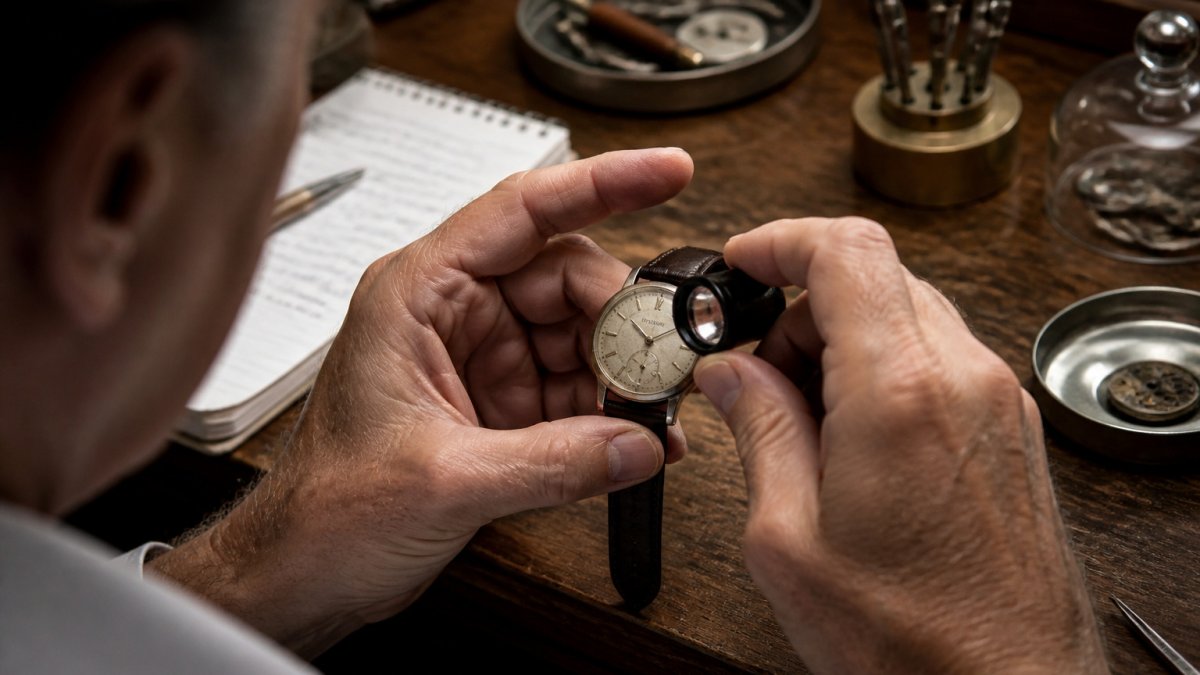
Step 2: Inspect the dial and hands. Look for original color, printing, and luminous material.
Step 3: Inspect the case. Check for polishing that has softened the edges, which reduces value and can hide damage. Look at the lugs, the caseback engravings, and the bevels.
Step 4: Check the crown, crystal, and bezel. Confirm originality where it matters and look for cracks, chips, or replacements.
Step 5: Review the movement. Ask for the watch to be run and, where possible, timed, and request a clear photo of the movement.
Step 6: Establish service history. Request documentation of past servicing and parts replaced.
Step 7: Assess water resistance honestly. Treat stated ratings cautiously.
A few transaction safeguards are worth building into every purchase:
- Pay with a method that offers buyer protection, such as a credit card or a marketplace escrow service, rather than a direct transfer with no recourse.
- Get the return window and condition guarantees in writing before you pay, including who pays return shipping.
- For auction purchases, read the buyer's premium, the condition report terms, and the return policy before bidding, since auction terms often differ sharply from retail.
- Keep all listing photos and messages, because they are your evidence if a dispute arises.
Run this checklist against every listing before you commit, and keep a copy of your answers.
Before committing to any listing, run through these steps in order to check the watch's reference, dial, case, movement, service history and seller terms.
| Step | What to check | Red flag |
|---|---|---|
| 1. Reference and period | Reference and serial numbers vs. production range | Numbers don't match the model's production period |
| 2. Dial and hands | Original color, printing and luminous material | Dial looks too uniform or refinished |
| 3. Case | Polishing, lugs, caseback engravings, bevels | Heavy polishing that softens edges |
| 4. Crown, crystal, bezel | Originality and cracks, chips or replacements | Undisclosed replacement parts |
| 5. Movement | Runs and times well; matches documented caliber | Movement doesn't match the reference |
| 6. Service history | Documentation of past servicing and parts replaced | No history; price in a service reserve |
| 7. Water resistance | Recent pressure test | Assume not safe for water unless tested |
| 8. Seller and terms | Written return policy and buyer protection | Pressure to buy fast or refused return rights |
Vintage Watch Maintenance Tips and Total Cost of Ownership
Owning a vintage watch involves costs beyond the purchase price. Plan for periodic servicing, along with gasket replacement, batteries for quartz models and insurance for valuable pieces.
Keep a simple record of every expense so you know what the watch truly costs to keep running. Wear the watch regularly to keep the lubricants moving, and avoid exposing it to water unless it has been tested for that use. For broader guidance on protecting valuable items, the National Institute of Standards and Technology guidance on measurement and product quality offers useful background on standards.
Booking Your First Vintage Watch Service or Restoration
When your watch needs attention, choose a workshop that explains what it will do before starting. Ask for a written estimate, a clear timeline and a description of which parts will be original and which replaced. Professional restoration is often worth the expense for a piece you intend to keep. Quotes for the same work can vary widely, so compare estimates carefully before committing.
Josef & Joseph is a boutique jewelry and timepiece workshop in Fort Lauderdale, and Josef personally handles watch repair and clock restoration by hand. Call Us About Your Piece to discuss its condition and what a careful restoration would involve.
Frequently Asked Questions
What is the 3 watch rule?
The 3 watch rule is a common collecting guideline suggesting you limit your collection to three watches: one for everyday wear, one for dress occasions, and one for sport or adventure. For a beginner buying a vintage piece, the rule is useful because it forces a clear purpose for each purchase. Before adding a watch, ask which of the three roles it fills and whether an existing piece already covers that role. It keeps spending focused and helps you build a collection you actually wear.
What should I look for when buying my first vintage watch?
Start with the movement type, the originality of the dial, hands and case, and the service history. Ask the seller whether the watch runs, how it keeps time over several days, and whether it has been opened or refinished. Check the water resistance rating against the crown and gaskets, and confirm the seller accepts returns or offers inspection time. Buying from a dealer with a written return policy reduces risk compared with a private sale.
How do I verify the authenticity of a vintage timepiece?
Compare the serial or reference number against the manufacturer's records or a published reference guide for that model and era. Examine the dial printing, lume color, font and crown logo under magnification, since replacement dials and parts often show small inconsistencies. Ask for provenance documents and any original box or papers. When the price is far below market value for a well-known model, treat that as a warning sign and request an independent inspection before paying.
How often does a vintage watch need professional servicing?
Most mechanical vintage watches benefit from a full service roughly every five to ten years, depending on use, storage and the movement's condition. A watch that runs erratically, loses significant time, or shows moisture inside the case should be serviced sooner. Ask a watchmaker for a written estimate before work begins, and confirm whether the quote covers parts, reassembly and timing adjustment. Regular servicing costs less than repairing damage caused by worn lubricants.
