

Table of Contents
- What Professional Jewelry Cleaning Actually Involves
- The Dangers of Ultrasonic Jewelry Cleaners and Other DIY Risks
- How to Tell if a Gemstone Setting Is Secure
- Average Cost of Jewelry Inspection and Cleaning
- Insurance and Warranty Implications of Skipping Professional Care
- How Often Should You Get Jewelry Cleaned and Inspected?
- Conclusion
- Frequently Asked Questions
Last Updated: September 26, 2026
What Professional Jewelry Cleaning Actually Involves
Professional jewelry cleaning is the process of restoring a piece's brilliance through controlled heat, solution, and mechanical action, paired with a hands-on inspection that a home routine cannot replicate. Every cleaning starts with examination under magnification, not with a dip in a jar. That order matters more than most people realize.
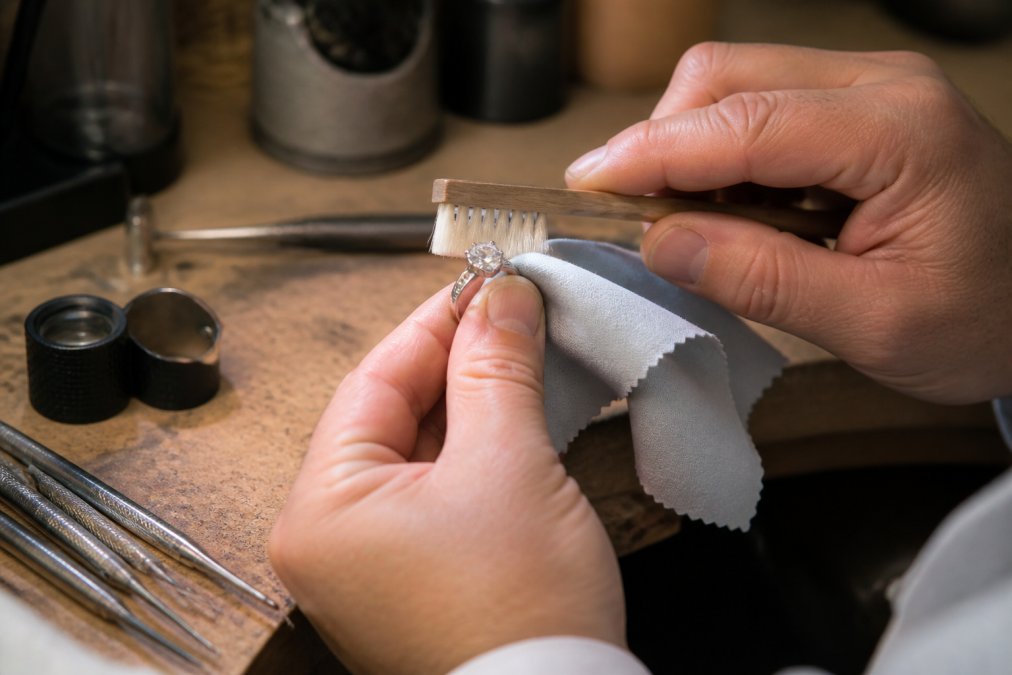
The Cleaning Process: Steam, Ultrasonic, and Hand Polishing
A trained jeweler typically works in three stages. First, steam cleaning lifts surface grime from metal and stone with pressurized vapor. Second, an ultrasonic cleaner uses high-frequency vibration to dislodge debris buildup from recesses a brush cannot reach. Third, hand polishing with a soft-bristled brush and a dedicated cloth restores luster without introducing micro-scratches.
The Inspection That Comes With It
The inspection is the part customers undervalue. Under a loupe, a jeweler checks prong inspection points, setting integrity, shank wear, and metal fatigue, looking for loose stones before they fall out. This is preventative maintenance in its purest form: catching a worn prong now costs far less than replacing a lost diamond later.
The Dangers of Ultrasonic Jewelry Cleaners and Other DIY Risks
Home ultrasonic jewelry cleaners are the most misunderstood tool in jewelry care. They work by generating high-frequency sound waves that create microscopic bubbles in a liquid; those bubbles implode against surfaces and lift away grime. That same cavitation energy is what makes them effective on diamond and plain gold, and what makes them destructive on the wrong piece.
The Safe vs. Unsafe List Most Guides Skip
Before any home cleaning, sort your piece into one of two buckets.
Generally safe for ultrasonic or warm soapy water:
- Diamond (untreated, no fracture filling)
- Ruby and sapphire (untreated)
- Plain gold, platinum, and sterling silver without oxidation you want to keep
- Amethyst, citrine, and most quartz-family stones
Never put these in an ultrasonic bath:
- Opal, porous and water-sensitive; vibration and heat can cause crazing (fine surface cracks)
- Pearl and coral, soft, organic, and easily dulled by chemicals or heat
- Emerald, almost always treated with oil or resin to fill natural fissures; ultrasonic action can strip the treatment
- Tanzanite, kunzite, and topaz, cleavable or heat-sensitive; vibration can fracture them along internal planes
- Fracture-filled diamonds, the filler can be dislodged, turning a clear stone cloudy
- Glued or bezel-set stones, and antique pieces with worn prongs, the setting itself is the weak point
Why the Setting Matters as Much as the Stone
A loose prong plus ultrasonic vibration is a stone-loss event waiting to happen. The vibration does not just clean the stone; it works the metal. On a ring that has been worn daily for years, prongs thin at the tips from normal abrasion. An ultrasonic cycle can be the final stress that lets a stone rotate or drop out. If you cannot verify prong integrity yourself, do not run the machine.
The Other DIY Risks, Ranked by How Often They Cause Damage
- Abrasive pastes and powders, toothpaste, baking soda, and whitening formulas contain particles harder than some gemstones and softer than others; on gold they leave micro-scratches that dull the finish over time
- Chlorine and ammonia, chlorine attacks the alloys in white gold and can pit the surface; ammonia is fine on diamond but damages pearls, opals, and treated stones
- Soap residue, a mild dish soap is safe, but if it is not fully rinsed, residue collects under the setting and attracts new debris, making the piece look dirtier within days
- Moisture left in crevices, trapped water accelerates tarnish on sterling silver and can discolor the underside of a setting
The Eco-Friendly Angle Most Guides Ignore
You do not need harsh chemicals to clean jewelry safely at home. Warm water with a drop of mild, fragrance-free dish soap and a soft-bristled brush handles most diamond, gold, and platinum pieces. For sterling silver, a paste of baking soda and water works on tarnish but should be rinsed completely and dried. Avoid bleach, acetone, and commercial "jewelry dip" solutions on anything porous or treated, the convenience is not worth the risk to the stone.
How to Tell if a Gemstone Setting Is Secure
You can check a setting at home in about a minute, and it is worth doing monthly. The test is simple: look, feel, and listen.
- Hold the piece under bright light and inspect each prong for gaps between the tip and the stone
- Gently press the stone with a fingernail to feel for any movement (never use force)
- Run a fingertip around the setting to catch a prong that has snagged or bent
- Check the shank for thin spots or cracks near the base of the setting
- Look for dark lines under the stone, a sign of trapped debris or a lifting setting
Average Cost of Jewelry Inspection and Cleaning
Cleaning and inspection pricing varies widely by piece and provider, and any shop quoting a flat number before seeing your jewelry is guessing. In practice, most jewelers price by complexity: a simple gold band takes minutes, while a multi-stone antique piece may need careful hand work.
Here is how the work typically breaks down:
| Service | What It Covers | Typical Pricing Basis |
|---|---|---|
| Basic cleaning | Steam, ultrasonic, polish | Flat fee per piece |
| Cleaning + inspection | Above, plus prong and setting check | Flat fee, sometimes waived with repair |
| Tightening or re-tipping prongs | Securing loose stones | Per prong, based on metal |
| Full restoration | Worn settings, refinishing, rhodium plating | Quoted after inspection |
Insurance and Warranty Implications of Skipping Professional Care
This is where skipping professional care gets expensive in ways most guides ignore. Many jewelry insurance policies and manufacturer warranties require reasonable care and periodic professional inspection, and a claim can be questioned if a piece shows clear signs of neglected maintenance. The mechanism is simple: when you file a claim for a lost or damaged stone, the insurer or warranty administrator looks for evidence that the piece was maintained.
How a Single Inspection Record Protects a Claim
A professional inspection produces three things that matter at claim time:
- A dated written record showing the piece was examined and the setting was secure as of that date
- A notation of any pre-existing wear, a thin prong, a slightly loose stone, so the insurer cannot later argue the condition was hidden
- A baseline for the piece's condition, which supports your account of how the loss occurred
Appraisals, Replacement Value, and the Gap That Costs Money
An inspection is not the same as an appraisal. An inspection documents condition; an appraisal documents value. If your appraisal is more than a few years old, your coverage limit may be below current replacement cost. Precious metal prices and diamond prices move, and a ring appraised at one value five years ago may cost significantly more to replace today.
Warranty Coverage: The Manufacturer's Side
Manufacturer warranties on settings and craftsmanship often condition coverage on professional inspection. A warranty that covers prong tightening or stone replacement may require that the work be done by an authorized jeweler and that the piece be inspected at set intervals. If you skip those inspections, the warranty administrator can deny a claim on the grounds that the required maintenance was not performed.
Practical Steps to Protect Yourself
- Keep a record of each professional inspection, including the date and any work performed
- Update your jewelry appraisal every few years so coverage reflects current replacement value
- Ask your insurer whether inspections are required and how often
- Store documentation with your policy, not in a drawer with the jewelry
- If a jeweler notes a worn prong, get the repair done and keep the receipt, it shows you acted on the inspection
A single dated inspection record can be the difference between a paid claim and a disputed one.
How Often Should You Get Jewelry Cleaned and Inspected?
For pieces worn daily, a professional cleaning and inspection once or twice a year is the common recommendation. Rings with high-profile settings, antique pieces, and anything with porous gemstones benefit from more frequent checks.
Conclusion
Jewelry cleaning is worth it when it includes inspection, and that is the part DIY methods cannot replace. A home routine handles surface grime; it will not catch a loosening prong before a stone is lost. If you own vintage, heirloom, or complex pieces, bring them to someone who examines before they clean. Josef & Joseph performs every cleaning and inspection by hand, backed by over 30 years of European master training, and handles delicate and antique pieces other shops decline.
Frequently Asked Questions
How much does jewelry cleaning usually cost?
A professional cleaning and inspection varies by piece and provider. The average cost of jewelry inspection and cleaning is often bundled, so ask what the fee covers before you commit.
Can professional cleaning damage delicate gemstones?
It can if the wrong method is used. Porous gemstones like opals, pearls, emeralds, and turquoise should never go into an ultrasonic cleaner or steam machine because the vibrations and heat can crack them or strip their finish. A trained jeweler will identify the stone first and choose hand cleaning with a soft-bristled brush and mild solution instead. Always tell your jeweler what stones are in the piece before any cleaning begins.
What is the 3-month ring inspection rule?
The 3-month ring rule is a guideline many jewelers recommend: bring your ring in every three months for a quick prong check and cleaning. This is especially important for engagement rings worn daily, where metal fatigue and shank wear can loosen a stone without any visible sign. A fast inspection catches loose stones before they fall out, which is far cheaper than replacing a diamond or resetting a stone.
How do I know if my gemstone setting is secure?
Look at the prongs under bright light. If any prong is bent, worn down, or no longer touches the stone, the setting is not secure. You can also gently tap the stone with a fingernail and listen for a rattling sound, which signals movement. Run a fingernail around the edge of the stone; if it catches on a gap, the stone may be loose. When in doubt, stop wearing the piece and have a jeweler check it.