

Table of Contents
- What Separates a Boutique Jewelry Workshop From a Chain Retail Store
- Quick Comparison: Fine Jewelry and Timepieces at a Glance
- Custom Engagement Rings in Fort Lauderdale: From Sketch to Setting
- Watch Repair in Fort Lauderdale: What to Expect From a Specialist
- Heirloom Jewelry Restoration Services: Reviving Pieces Others Decline
- How to Vet a Jeweler Before You Hand Over a Family Piece
- Jewelry Care and Maintenance: What a Local Workshop Can Do Between Visits
- Frequently Asked Questions
Last Updated: September 27, 2026
What Separates a Boutique Jewelry Workshop From a Chain Retail Store
Finding fort lauderdale jewelry stores that actually repair what they sell is harder than it sounds. At Josef & Joseph, we've watched customers walk in with pieces that three mall counters refused to touch. That gap between selling and servicing defines the local market.
Quick Comparison: Fine Jewelry and Timepieces at a Glance
Buying fine jewelry and timepieces comes down to matching the piece to how you'll wear it. Here's how a few pieces from our own case compare across the categories customers ask about most.
| Piece | Price | Category | Best For |
|---|---|---|---|
| Breitling Callistino Two Tone 18k Gold/Steel | $1,800.00 | Luxury watches | First fine timepiece, daily wear |
| Ball Roadmaster Ocean Explorer Automatic | $3,299.00 | Luxury watches | Sport and travel |
| 14K White Gold Diamond Filigree Ring | $3,625.00 | Fine jewelry | Bridal and anniversary |
| 14K Yellow Gold Diamond Tennis Bracelet | $4,475.00 | Fine jewelry | Everyday luxury |
| Rolex Oyster Speedking Precision | $5,800.00 | Estate pieces | Collectors of vintage |
| Chopard Happy Sport - Happy Butterfly | $6,740.00 | Luxury watches | Statement wear |
| Cartier Roadster Chronograph | $7,000.00 | Luxury watches | Collector investment |
| Breitling Montbrillant 01 Chronograph | $14,800.00 | Luxury watches | Serious collectors |
How to Read the Price Column
Price in this category reflects four things, not one: the movement or stone quality, the metal content, the brand's service network, and the condition of the specific piece. A two-tone Breitling at $1,800 and a Cartier Roadster at $7,000 can both be excellent buys, they simply sit in different tiers of those four variables.

- Movement and stone quality. An automatic Swiss movement with a chronograph complication carries more service complexity than a two-hand quartz or a simple mechanical. A diamond's cut, color, clarity, and carat weight drive value the same way across every brand.
- Metal content. 18k gold holds more intrinsic value than gold plating or steel, and two-tone pieces split the difference. Ask what the case and bracelet are actually made of before comparing two prices.
- Service network. Brands with authorized service channels and available parts cost more upfront but are easier to maintain over decades. A discontinued reference can be a bargain or a headache depending on whether parts exist.
- Condition. Estate and vintage pieces are priced on originality. An unpolished case with original dial furniture is worth more than a heavily refinished one, even at the same model number.
Fine Jewelry vs. Timepieces: Which Should You Buy First
A common pattern among first-time buyers is to start with a piece that gets worn, not stored. A diamond tennis bracelet or a filigree ring earns its cost through daily use; a collector-grade chronograph earns its cost through preservation.
What to Ask Before You Buy Any Piece on This List
- Is the movement serviced, and when?
- Are the stones graded, and by whom?
- Is the metal content stamped and verified?
- Does the piece come with original documentation?
- What is the return or exchange window?
- Who services it after the sale, and where?
Those six questions separate a confident purchase from a hopeful one, and any reputable workshop will answer all of them without hesitation.
Custom Engagement Rings in Fort Lauderdale: From Sketch to Setting
A custom engagement ring starts with a conversation, not a catalog. The process runs through design, wax model, casting, stone setting, and finishing, and each stage is a decision point where you can change direction.
Watch Repair in Fort Lauderdale: What to Expect From a Specialist
Heirloom Jewelry Restoration Services: Reviving Pieces Others Decline
Heirloom jewelry restoration services exist for the pieces that fall outside normal repair. Bent filigree, worn prongs, missing stones, stretched chains, and clasps that no longer hold all fall into this category.
How to Vet a Jeweler Before You Hand Over a Family Piece
Vetting a jeweler takes about fifteen minutes and saves months of regret. Ask direct questions, listen for specifics, and watch how they handle the piece itself.
- Ask who performs the repair and where the bench is located
- Request examples of similar work on comparable pieces
- Confirm whether the quote is binding or an estimate
- Ask what happens if a part cannot be sourced or fabricated
- Check whether they insure pieces while in their possession
- Get the timeline in writing, including any dependency on parts
- Ask about the warranty on the work itself
Jewelry Care and Maintenance: What a Local Workshop Can Do Between Visits
Care and maintenance extend the life of fine jewelry far more than most owners expect, and most national chain store locators never cover it because they don't have a bench to send you to. A workshop can do things at the bench that no home kit can replicate.
What Happens at a Professional Cleaning
Professional cleaning removes buildup from behind stones where a toothbrush can't reach. Ultrasonic and steam cleaning, when appropriate for the stone, restores brilliance that looks like new metal.
Breitling Montbrillant 01 Chronograph →
The Services Most Owners Skip
Prong tightening is the highest-value service most people skip. A loose prong is invisible until the stone is gone, and replacing a diamond costs many times more than a five-minute check.
Other bench services worth scheduling on a regular cadence:
- Clasp and chain inspection. A stretched chain or a clasp that no longer seats is a loss waiting to happen. Rebuilding a clasp is inexpensive; replacing a lost pendant is not.
- Ring shank wear. Gold thins at the bottom of a ring over years of wear. A jeweler can add metal before the shank cracks, which is far cheaper than a full shank replacement.
- Stone tightening across a setting. Tennis bracelets and multi-stone bands have dozens of contact points. One loose stone can cascade.
- Rhodium replating on white gold. White gold is rhodium-plated to achieve its bright finish, and the plating wears off with time. Replating restores the color and protects the alloy underneath.
Watch Servicing Intervals
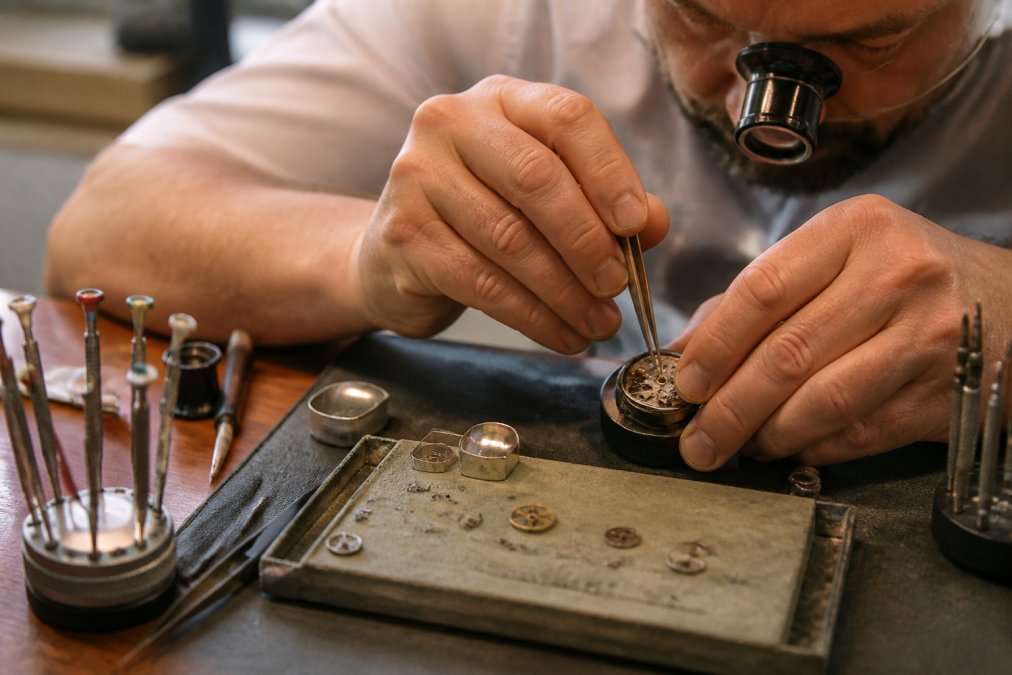
For watches, periodic servicing keeps lubricants from drying and metal from grinding. A timepiece repair specialist will tell you the interval depends on the movement and how often you wear it. A common rule of thumb is every five to seven years for a mechanical watch in regular rotation, but a piece worn daily in a humid climate may need attention sooner, and a quartz movement mostly needs a battery and gasket check.
Ethical Sourcing and Sustainability
Ethical sourcing deserves a mention here too. Ask where stones and metals come from, and expect a straight answer about conflict-free diamonds. Reputable workshops know their supply chain and will say so. The Kimberley Process overview is the baseline most dealers reference for rough diamond controls, and recycled gold is increasingly available for custom work if that matters to you.
How to Store and Care for Pieces at Home
Between visits, store pieces separately, keep them away from household chemicals, and take them in for a check before any big event. A few specifics that make a difference:
- Store each piece in its own soft pouch or compartment so harder stones don't scratch softer ones.
- Put jewelry on last, after perfume, lotion, and hairspray have dried.
- Remove rings before swimming, gardening, or lifting weights.
- Wipe pieces with a soft cloth after wear to remove skin oils and residue.
- Keep silver in a tarnish-resistant pouch or an airtight container with anti-tarnish strips.
Frequently Asked Questions
How do I choose a reputable jeweler for custom engagement rings in Fort Lauderdale?
Start by asking who actually performs the work. A workshop where the master jeweler handles the design and setting by hand gives you a single point of accountability. Ask to see finished custom pieces, confirm the timeline in writing, and request a no-commitment consultation so you can judge the design process before paying a deposit. Josef & Joseph, for example, builds each ring from scratch with over 30 years of European master training behind the bench.
What should I look for when selecting a jeweler for watch repair in Fort Lauderdale?
Look for a shop that services mechanical and quartz movements in-house and can fabricate parts that are no longer manufactured. Ask whether the watchmaker has handled vintage or complex calibers before, and whether you will receive a clear estimate before work begins. Josef & Joseph restores vintage and heirloom timepieces that other shops decline, with all work performed by hand by Josef personally.
Are there local jewelers that specialize in heirloom jewelry restoration services?
Yes, but the specialty is narrow. Heirloom restoration requires a jeweler comfortable working with fragile settings, older alloys, and stones that may need re-cutting or re-tipping. Ask for examples of restored estate pieces and confirm the shop can source or fabricate missing components. Josef & Joseph specializes in reviving complex, vintage, and heirloom pieces that other shops turn away.
How often should I have my fine jewelry professionally inspected and cleaned?
A good rule is once every six to twelve months for pieces you wear daily, such as engagement rings and tennis bracelets. A jeweler will check prongs, tighten settings, and clean the piece properly. If you notice a loose stone, a bent prong, or a clasp that no longer snaps firmly, bring it in sooner rather than waiting for the next scheduled visit.